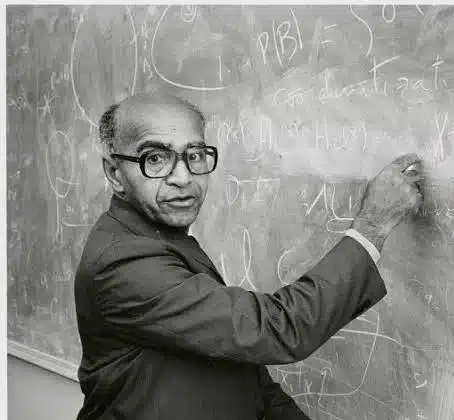
David H. Blackwell built a singular career that combined deep theoretical insight with quiet moral force. Rising from humble roots in Centralia, Illinois, he became a pioneering mathematician and statistician whose work reshaped probability theory, game theory and decision science. Along the way he broke racial barriers — becoming the first African American elected to the U.S. National Academy of Sciences and the first Black tenured professor at UC Berkeley — while mentoring generations of students and producing results of enduring technical importance. Below are 15 concise things to know about his life, work and legacy.
- Early prodigy: Born April 24, 1919, Blackwell finished high school at 16 and completed a B.A. (1938), M.A. (1939) and Ph.D. (1941) in mathematics at the University of Illinois by age 22.
- Dissertation and Markov chains: His 1941 thesis, “Some Properties of Markov’s Chains,” launched a lifelong focus on stochastic processes and Markov decision problems that became central to his research.
- Rosenwald Fellow at the Institute for Advanced Study: A Rosenwald Fellowship brought him to the IAS in 1941–42, where he met leading mathematicians and forged connections that shaped his career despite discriminatory barriers tied to nearby Princeton University.
- Early career obstacles and HBCU service: Racial discrimination limited mainstream academic offers. Blackwell taught at Southern University and Clark College, then joined Howard University (1944–54), becoming mathematics department chair and building a strong research and teaching record.
- RAND summers and game theory: Summers at the RAND Corporation (1948–50) introduced him to sequential analysis and game theory. There he explored optimal stopping problems and the “duelist’s dilemma,” applying rigorous probability to strategic decision-making.
- Seminal collaboration and book: With Meyer Girshick he co‑authored Theory of Games and Statistical Decisions (1954), an influential work that linked game theory with statistical decision theory and helped frame modern sequential decision problems.
- Berkeley appointment and leadership: Hired by UC Berkeley in 1954, Blackwell became the first Black tenured professor at the university, helped found the Statistics Department, served as chair (1957–61) and later as assistant dean.
8. Rao–Blackwell improvement and estimator theory: He is closely associated with the Rao–Blackwell approach to improving estimators—using conditional expectation to reduce variance—and contributed fundamentally to the theory of comparison of experiments and sufficiency.
9. Contributions to dynamic programming: Blackwell made major advances in Markov decision processes and dynamic programming, work recognized with the 1979 John von Neumann Theory Prize for its impact on control, operations research and applied probability.
10. Bayesian pedagogy and Basic Statistics: His textbook Basic Statistics (1969) introduced Bayesian ideas and multistage decision concepts to a broader audience, influencing how generations of statisticians approached inference under uncertainty.
11. Mentor of many: Blackwell supervised more than 50 Ph.D. students and was celebrated for patient, generous mentorship—emulating the support he received from mentors like Joseph Doob and learning from encounters with John von Neumann.
12. Barrier‑breaking honors and service: In 1965 he became the first African American elected to the National Academy of Sciences. He held leadership roles in major societies, garnered numerous awards and received a dozen honorary doctorates.
13. Elegant problem‑solving style: Colleagues admired his ability to find simple, decisive insights in complex problems. Rather than narrow specialization, he moved across fields—probability, game theory, decision theory—leaving a fundamental paper in each.
14. Personal life and values: Married to Ann in 1944, Blackwell raised eight children and frequently cited family as his proudest achievement. He described himself as driven by a desire to understand rather than by publication counts, emphasizing clarity and pedagogy.
15. Enduring legacy: Retiring from Berkeley in 1988 and passing away on July 8, 2010, at 91, Blackwell left a rich body of theoretical results and a culture of mentorship. His work on Markov processes, comparison of experiments, the Rao–Blackwell improvement, and statistical decision theory continues to underpin research across statistics, economics, engineering and computer science — and his life remains a powerful testament to perseverance and scholarly generosity.