
A Basic Framework For Teaching Critical Thinking In School
by Terrell Heick
In What Does Critical Thinking Mean?, we offered that ‘(c)ritical thinking is the suspension of judgment while identifying biases and underlying assumptions to draw accurate conclusions.’
Of course, there are different definitions of critical thinking. The American Philosophical Association defines it as, “Critical thinking is the ability to think clearly and rationally, understanding the logical connection between ideas. It involves being active (rather than reactive) in your learning process, and it includes open-mindedness, inquisitiveness, and the ability to examine and evaluate ideas, arguments, and points of view.”
But understanding exactly what it is and means is different than teaching critical thinking–that is, consistently integrating it in your units, lessons, and activities. Models and frameworks have always been, to me, helpful in making sense of complex (or confusing–which is generally different than complex) ideas. I also find them to be a wonderful way to communicate any of that sense-making.
Put another way, models and frameworks can help to think about and communicate concepts.
See also Examples Of Analogies For Critical Thinking
A Framework Integrating Critical Thinking In Your Classroom
Obviously, teaching critical thinking in a classroom is different than ‘teaching’ it outside of one, just as it differs from the active practice and application of critical thinking skills in the ‘real world.’ I have always taught students that critical thinking is something they do seamlessly in their lives.
They analyze plots and characters in movies.
They create making short videos.
They critique relationships and punishments and grades and video games.
They evaluate their favorite athletes’ performance and make judgments about music.
And so on. With that context out of the way, let’s have a look at the framework, shall we?
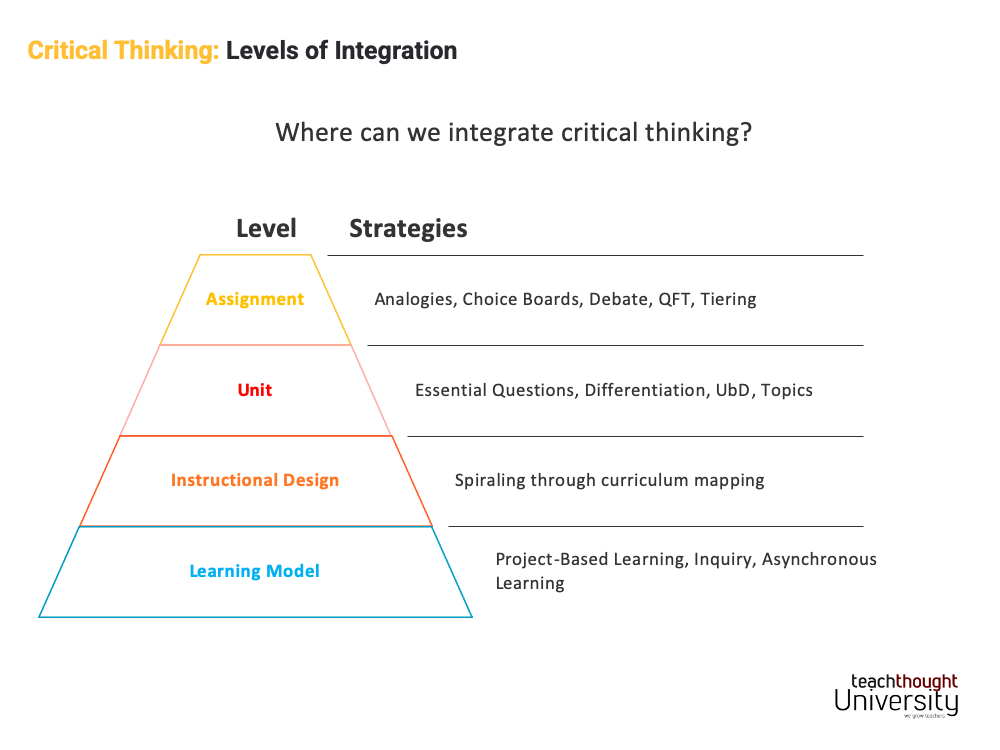
Levels Of Critical Thinking Integration
From individual tasks to full learning models, each level offers specific strategies and classroom examples.
Level 1 · Assignment
Critical thinking in individual tasks
Single assignments and activities require students to compare, judge, explain, or revise rather than only recall or copy.
Strategies for integration
- Analogies that connect new ideas to familiar ones
- Choice boards that require justification of selections
- Structured debates on claims or interpretations
- The Question Formulation Technique
- Tiered tasks that increase cognitive demand
- Think alouds and student explanation routines
Examples
- Students create analogies and explain the limits of each.
- Choice board selections must be justified in writing.
- Mini debates that require two pieces of evidence.
- Students generate questions and label those requiring judgment.
- A task set that ends by comparing methods or solutions.
- A think aloud where peers identify key decision points.
Level 2 · Unit
Critical thinking as the frame of study
Units are built around questions, problems, or ideas that cannot be addressed without analysis, evaluation, and explanation.
Strategies for integration
- Essential questions that highlight uncertainty
- Differentiation that offers varied paths to complex thinking
- Understanding by Design and backward planning
- Selecting topics that invite multiple perspectives
- Embedding dilemmas or conflicts as learning drivers
- Recurring text sets, data sets, or cases for comparison
Examples
- A literature unit around “What makes a character believable?”
- A science unit built on “When should we trust a model?”
- A history unit organized around “Whose story is this?”
- A math unit evaluating which solution method is most transparent.
- A health unit where students weigh tradeoffs and defend choices.
- Students revisit the essential question at three stages to show growth.
Level 3 · Instructional Design
Critical thinking built into sequencing and structure
Curriculum maps, spirals, and assessment plans reinforce thinking routines across time rather than in isolated experiences.
Strategies for integration
- Spiraling concepts and questions across units
- Using the 6 Facets of Understanding to design performances
- Reasoning rubrics shared across subjects
- Planned revision cycles within units
- Vertical alignment of explanation and argumentation skills
- Recurring reflection prompts built into pacing guides
Examples
- Quarterly return to “What makes evidence convincing?” across courses.
- English and social studies use the same reasoning rubric.
- Students revise earlier conclusions with new evidence.
- Routine comparison of evolving interpretations.
- Performance tasks requiring students to explain and apply ideas.
- Weekly use of “What changed your mind?” as a reflection prompt.
Level 4 · Learning Model
Critical thinking as the structure of learning
Thinking becomes identity. Learning models assume that students investigate, question, and justify as normal.
Strategies for integration
- Project based learning
- Inquiry driven instruction
- Asynchronous self directed learning
- The Heick Learning Taxonomy
- Studio or workshop critique systems
- Mastery or competency based progression
Examples
- A year long project course where reasoning is the main metric.
- Inquiry units beginning with student generated questions.
- Learning contracts that include justification of chosen resources.
- Studio critiques focused on logic and evidence.
- Competency progression tied to clarity of reasoning.
- Students naming the type of thinking they are doing using a taxonomy.
Level 1: Assignment-Level Integration Strategies
Purpose / Idea
Assignment level integration is where students most naturally encounter critical thinking in your classroom. The learning activity itself requires them to interpret, judge, compare, infer, or revise rather than simply recall.
- Analogies (see also Teaching With Analogies)
- Choice boards
- Debate
- The Question Formulation Technique
- Tiering
Concrete examples
- Students rank three solutions and explain the order they chose.
- Students compare two character motivations in a story and support their thinking with evidence from the text.
- Students critique a lab conclusion using simple criteria the class develops together.
- Students annotate their thinking with short notes like “I changed my mind here because…”
Examples of integration strategies :Analogies (see Teaching With Analogies); Choice Boards; Debate; The Question Formulation Technique; Tiering
Level 2: Unit-Level Integration Strategies
Purpose / Idea
At the unit level, critical thinking moves from separate activities to a kind of organizing frame. Instead of a unit being about covering content, it becomes about returning to a question, problem, or idea that cannot be understood without analysis and judgment.
Your existing strategies
Unit level integration strategies include:
Concrete examples
- A unit built around “What makes an explanation good?” rather than simply “Photosynthesis.”
- Assessments that require students to compare two interpretations or solutions and justify which is stronger.
- Students revisiting an essential question at the beginning, middle, and end of the unit to show how their thinking changed.
Topics (i.e., learning about topics that naturally encourage or even require critical thinking)
See also 6 Critical Thinking Questions For Any Situation
Level 3: Instructional Design-Level Integration Strategies
Purpose / Idea
At the instructional design level, critical thinking is built into the structure of learning across time. Sequencing, spiraling, and curriculum mapping are used to help students meet and revisit ideas in ways that require them to think more clearly and more often.
Concrete examples
- A sequence where students build, test, and revise claims across multiple units rather than in a single project.
- Rubrics that evaluate clarity of reasoning in more than one subject or unit.
- A pattern where students return to earlier work and revise it with new evidence or more mature thinking.
Level 4: Learning Model Level Integration
Purpose / Idea
At the learning model level, critical thinking is not something added to existing work. It becomes the structure of learning. Models like project based learning, inquiry, and self directed learning assume that students will investigate, question, and justify as a normal part of how learning works.
Learning model level integration strategies include:
Concrete examples
- A project based unit where the quality of student decisions and reasoning matters more than the polish of the final product.
- An inquiry unit where students generate their own questions, design investigations, and defend their conclusions.
- A self directed learning structure where students select resources, evaluate their usefulness, and justify their learning pathway.
-Project-Based Learning (see 25 Questions To Guide Teaching With Project-Based Learning)
-Inquiry Learning (see 14 Teaching Strategies For Inquiry-Based Learning)
-Asynchronous Self-Directed Learning (see our Self-Directed Learning Model)