
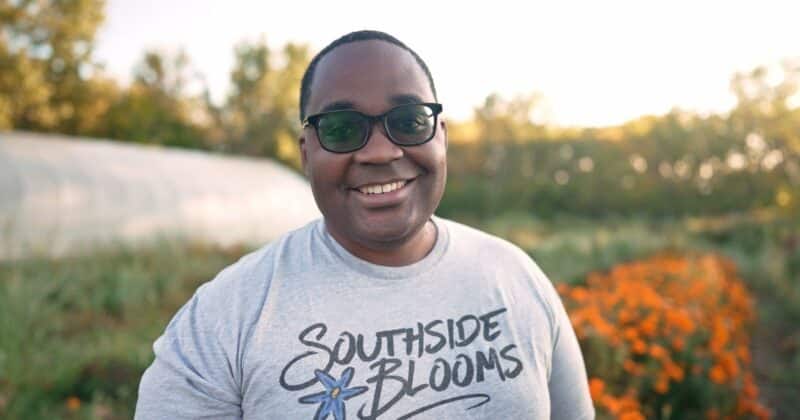
Quilen Blackwell, founder of Southside Blooms, was named CNN’s Hero of the Year for 2025, recognized for transforming vacant lots in one of Chicago’s most dangerous neighborhoods into thriving flower farms that employ at-risk youth. The 40-year-old has turned an unlikely solution—flowers—into a powerful tool for fighting urban poverty and creating opportunity in Englewood, a community where hope can be hard to find.
1. His Roots Trace Back to the Great Migration
Blackwell is the maternal grandson of Arkansas sharecroppers who moved to Milwaukee during the Great Migration to secure factory jobs and escape the Jim Crow South. His father grew up in Milwaukee’s inner city during the turbulent aftermath of the Civil Rights Movement, experiencing firsthand the racial tensions of that era. His parents later moved to Madison, Wisconsin, seeking a more stable environment to raise their children.
2. He Grew Up With Every Advantage
Unlike many of the young people he now serves, Blackwell grew up in an ideal setting as part of a prosperous dual-income family in Madison. He had access to excellent schools and opportunities that allowed him to thrive. This privileged upbringing would later fuel his sense of duty to help those who weren’t as fortunate.
3. He Served in the Peace Corps in Thailand
After earning a bachelor’s degree from the University of Wisconsin-Madison, Blackwell joined the Peace Corps and served in rural Thailand. This experience sparked his interest in environmental sustainability and exposed him to creative solutions for poverty in under-resourced communities—lessons he would later apply in Chicago.
4. Ministry School Led Him to Englewood
In 2011, Blackwell enrolled in ministry school at a small Christian school in Chicago’s western suburbs. This inspired him to commit to community service, and he began tutoring at a high school in Englewood. “I started to just realize, I could be any one of these kids,” he said. “They’re people who want a chance at something better.”
5. He Was Shocked by the Severity of Inner-City Poverty
Through his tutoring work, Blackwell encountered the harsh realities of Englewood: hundreds of vacant properties, a 22% overall unemployment rate, 50% unemployment among Black youth, and a 44% poverty rate. The neighborhood is also one of Chicago’s most dangerous, with high rates of gun violence. Witnessing this suffering firsthand, he felt a duty—particularly as a Christian—to dedicate his life to helping his fellow Black people.
6. He Founded Chicago Eco House in 2014
In 2014, Blackwell assembled a team of young adults to launch Chicago Eco House, the organization that would become the foundation for his flower farm initiative. During this planning phase, he met Hannah Bonham, who was also committed to serving Chicago’s inner city and living on the West Side. They married, and she became his partner in the mission.
7. He Lives in the Heart of Englewood With His Family
In 2015, Blackwell and Hannah bought a home in Englewood, where they’ve raised their three children and established their nonprofit. “If you’re really going to earn people’s respect … you have to walk a mile in their shoes, so to speak. And what that means is living in the heart of Englewood,” he explained. Their commitment to living in the community they serve has been crucial to building trust.
8. Flowers Were an Unexpected Solution
While helping turn a vacant lot into a community farm in 2015, Blackwell discovered that growing food meant navigating complex regulations, access to clean water, and soil contaminated with toxins. Researching alternatives, he learned that the U.S. spends billions on cut flowers annually—and more than 70% are imported.
“I said, ‘Wait a minute. Why are we importing flowers from other countries when we have all this land, all of this youth?’” he recalled. “Maybe flowers are the answer.”
9. Southside Blooms Now Operates Six Off-Grid Farms
Since 2017,Blackwell has transformed six vacant lots into off-grid flower farms across Chicago, growing everything from amaranth to zinnias using sustainable practices that go “beyond organic.” Rainwater harvesting systems collect water from nearby roofs, solar panels power irrigation, and no chemical fertilizers, insecticides, or fungicides are ever used. He’s even found a way to grow thousands of tulips in his basement during Chicago’s harsh winters, ensuring year-round employment and Valentine’s Day flowers.
The farms employ 25 local young people who grow, arrange, and sell flowers through the nonprofit shop, Southside Blooms, which opened in 2019. Hannah runs the shop and serves as lead floral designer, while Quilen manages the farms. The “farm-to-vase” florist handles everything from retail bouquets and high school prom corsages to weddings and corporate events at venues like the Field Museum. Their slogan captures the mission: “Flowers that empower.”
10. He’s Changing Lives One Employee at a Time
Dionta White, 28, represents the transformation Blackwell hopes to create. Growing up in Englewood, White fell into street life and lost friends to gun violence. After serving time for burglary, he wanted to change but was skeptical when a friend told him about the flower farm. “I’m like, ‘Bro, flowers? What?’” he recalled.
That was in 2022. Now White is a senior farm team member responsible for growing flowers and training new employees. “Working here, I seen myself changing … calmer, more into nature,” he said. “It feels good to let people see Englewood for a different point of view instead of violence, gangbanging and killing. When we grow these flowers, it just bring(s) peace to the community.”
For Blackwell, the parallel between growing flowers and developing young people is clear. “Give them the right opportunity … the right support structures, and then all of a sudden you see the beauty of their lives shining for all to see,” he said. “Our young people are blossoming and blooming every single day.”