
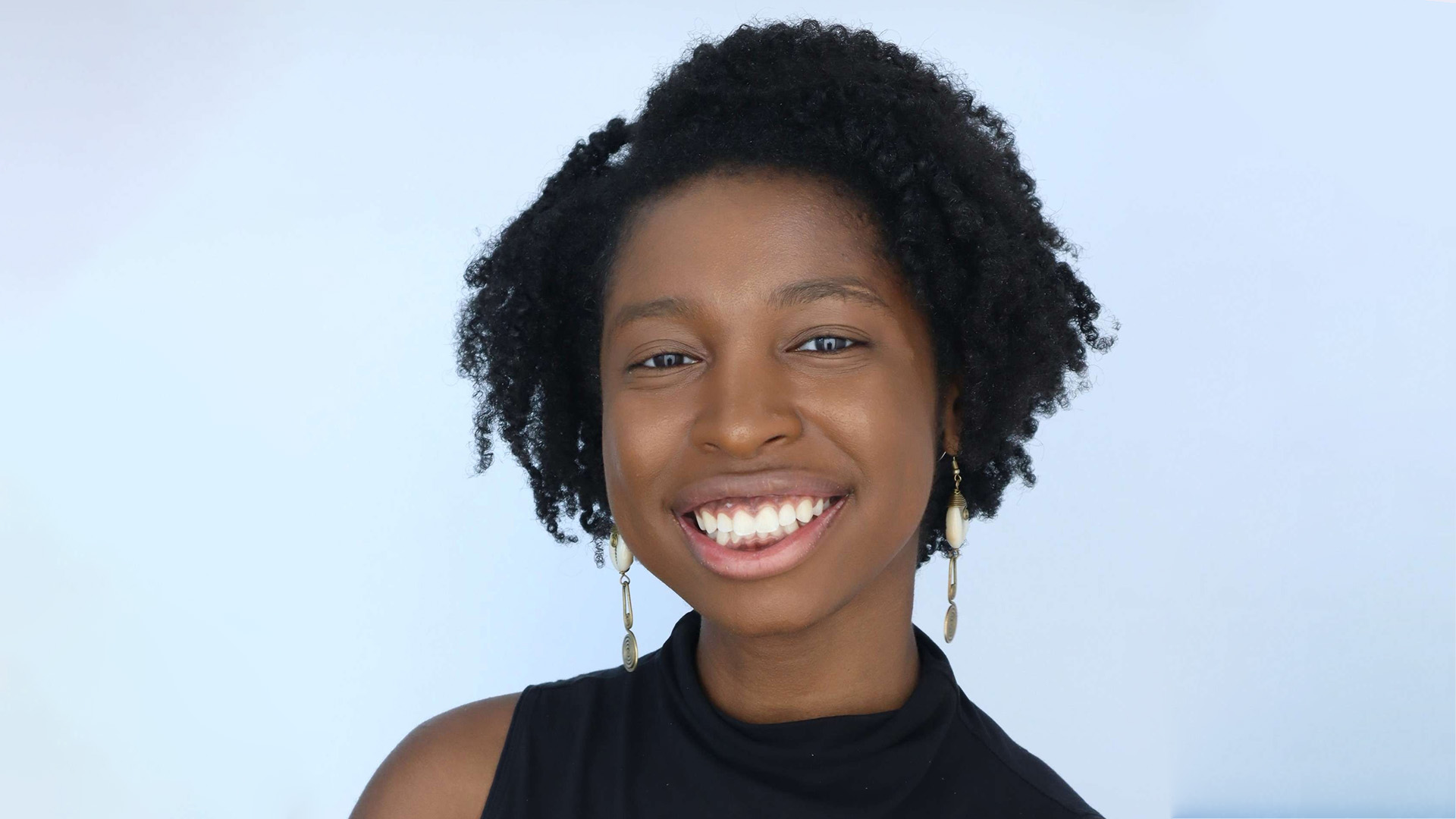
Blanca Burch is shedding light on the misrepresentation of Black hairstyles by AI.
The Milwaukee native attended an immersion school for elementary and middle school. She spent half her days speaking French and the other half speaking English, which she credits with giving her a global perspective and sparking her curiosity about areas beyond her immediate community.
When she attended Spelman College, she initially entered as a psychology major but later pivoted to international relations and affairs with a focus on East Asia.
“I had been studying Japanese for about a year when I first came to Spelman. So I figured that would be a fun path to take,” she told AFROTECH™.
She took a course at the HBCU’s Arthur M. Blank Spelman Innovation Lab as a junior, a makerspace that supports “creative inquiry, unconventional research, experimental pedagogy, and exploratory play” to help students in art, science, technology, and engineering, its website reads.

After completing her studies at Spelman College in 2022, landed a role at Microsoft’s Atlanta office as a lab manager for its makerspace. She was tasked with empowering the greater Atlanta area and Microsoft’s employees to use AI, primarily Copilot.
Toward the end of her time at Microsoft, she began dabbling with different AI tools and, in doing so, recognized that certain Black hairstyles generated by AI weren’t accurately portrayed.
“I noticed particularly with braided hairstyles, it struggled quite a bit. So you could say, “Box braids,” and it could get that. But if you were to say, “What would it be like with lemonade braids,” those, it would be a little shaky. Also with locs, faux locs, and butterfly locs. It struggled a little bit in creating definition between all of those hairstyles,” she recalled.
In The Context Of Curls
These observations turned into a study titled “In the Context of Curls,” which helps train AI on braided and textured hairstyles. Burch generated more than 600 images of various hairstyles using Adobe Firefly, OpenAI’s DALL-E, Ideogram, and Midjourney. Then she reduced the number to about 20 to 40 per survey and gathered participants to determine which hairstyle they believed they were looking at. The study included a separate section on hair textures.
If 51% of respondents agreed with the AI’s depiction of a hairstyle and texture, Burch determined the image was accurate, she told AFROTECH™. She hopes to survey at least 200 participants by the end of 2026.
Interested participants can fill out a form to evaluate the accuracy of these images.
“My goal is to educate the researchers and creators of these tools that all different communities, cultures, and backgrounds matter in representation because it’s being integrated into so many different parts of our lives. And representation is key, especially accurate representation,”
“And then people who may just be consumers of these AI tools, I hope that this kind of research and them filling out the survey will empower them to give feedback while we’re at the start of this technological era, and they’re changing things almost every day,” she continued.
Beyond Burch’s study, she is providing hands-on learning opportunities at Spellman’s Arthur M. Blank Innovation Lab to ensure students, faculty, and staff can “gain fluency in AI tools and ethics while imagining how these technologies can serve their fields,” according to a news release.
She has led workshops in Prompting Power: AI at Your Fingertips, Safely Engaging with AI, My GPT, My Way, AI Runway Remix, AI Research Lab, AI in Your Pocket, and Prototyping Your App or Website in Minutes.
