
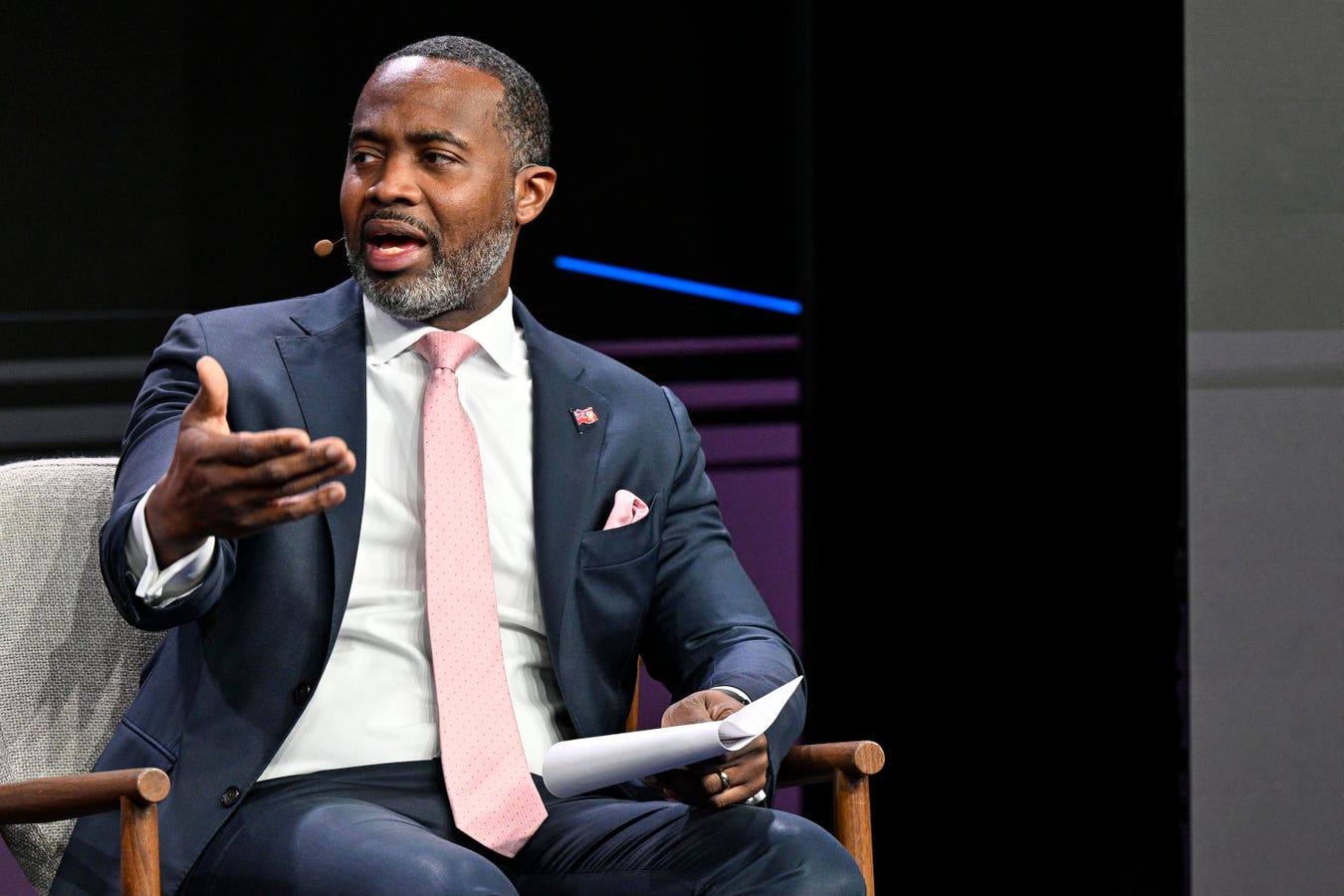

NEW YORK, NEW YORK – NOVEMBER 05: E. David Burt, Premier of Bermuda, attends the Chainlink’s SmartCon 2025 at Metropolitan Pavilion on November 05, 2025 in New York City. (Photo by Eugene Gologursky/Getty Images for Chainlink Labs)
Getty Images for Chainlink Labs
Bermuda was among the earliest jurisdictions to establish a comprehensive regulatory framework for digital assets in 2018, attracting companies seeking regulatory clarity as enforcement tightened elsewhere. That early adoption has since become a defining feature of the island’s approach.
While at the SmartCon conference in December, I spoke with Bermuda’s Premier, David Burt, and asked what lesson larger economies could take from Bermuda’s experience with digital assets. He framed digital finance as a structural transition rather than a race for speed or control, comparing it to earlier shifts from paper-based systems to electronic rails.
As governments and regulators set priorities for the year ahead, the question is no longer whether digital assets belong in the financial system, but how deliberately they should be integrated.
The challenge for governments, in Burt’s view, is engaging with crypto without rushing immature frameworks or attempting to dictate outcomes in a fast-moving industry. “It’s important that you give the private sector the tools, the space, the ability to innovate,” Burt said in an interview with me, arguing that regulation works best when it creates boundaries rather than blueprints for a market that is still evolving.
In a 2019 Forbes interview, Burt outlined a similar philosophy: regulatory clarity without micromanagement, caution without fear, and confidence that markets, even volatile ones, tend to function better when given room to evolve.
Today, Bermuda’s framework supports a wide range of regulated digital-asset activity. The Bermuda Monetary Authority licenses crypto exchanges, yield-bearing stablecoin structures, and decentralized finance protocols under a single supervisory regime. Tokenized money market funds operate within the jurisdiction, and digital-asset-native insurers are permitted to hold reserves, collect premiums, and pay claims in crypto, all under traditional financial oversight.
Tangible Signals
Bermuda’s strategy has generated noticeable business traction. In late 2024, the BMA issued the world’s first license for a DAO-governed decentralized derivatives exchange. The jurisdiction also hosts regulated derivatives operations tied to major exchanges, including Coinbase and Kraken, reflecting continued institutional interest in operating within a clear supervisory framework. In addition, Bermuda has attracted utility-focused firms like Haycen, which uses specialized stablecoins to provide faster trade financing, bridging the funding gaps often missed by traditional banks.
As crypto’s center of gravity shifts away from speculation toward function, the next phase of digital assets is defined by asset tokenization, the convergence of traditional finance and decentralized systems, and the expectation that value should move more efficiently than legacy infrastructure allows. These developments are more about integration than disruption.
Burt’s argument is not that digital finance can be insulated from risk. “In life you can’t insure anything,” he said in an interview with me, underscoring the limits of government control in any financial system. Instead, Burt argued that policymakers must balance caution with humility and avoid dictating outcomes in a sector that is still young, leaving room for innovation within a sound regulatory framework.