
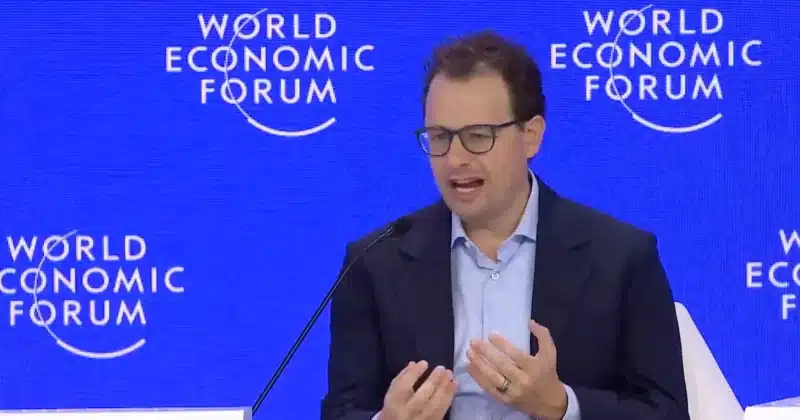
Anthropic CEO Dario Amodei has warned that artificial intelligence could soon handle most of the work currently done by software engineers, predicting a dramatic shift in the profession within the next year.
Speaking at the World Economic Forum in Davos during a session moderated by Zanny Minton Beddoes, Editor-in-Chief of The Economist, Amodei said AI models are rapidly approaching the point where they can manage software development “end to end.”
“I have engineers within Anthropic who say I don’t write any code anymore. I just let the model write the code, I edit it. I do the things around it,” Amodei said. “I think… I don’t know… we might be six to twelve months away from when the model is doing most, maybe all of what SWEs (software engineers) do end to end. And then it’s a question of how fast does that loop close.”
By “loop,” Amodei was referring to a self‑reinforcing cycle in which AI systems write code, help conduct AI research, and are then used to build even more capable models. In theory, that could accelerate progress as each generation of AI tools improves the next. However, he noted that certain parts of this loop still depend heavily on the physical world.
He cited chip manufacturing, the production of those chips at scale, and the time required to train ever larger models as key bottlenecks that AI cannot yet remove. “I think there’s a lot of uncertainty,” he said, suggesting that while software work might be largely automatable soon, full AI self‑improvement could still take years.
Amodei’s remarks came in a joint appearance with Google DeepMind CEO Demis Hassabis, who broadly agreed that AI is already reshaping how coding and research are done but was more cautious about timelines for fully closing the loop.
“AI can already assist with coding and some aspects of research,” Hassabis said, adding that the “full closing of the loop” remains an open question. “I think it is possible to do, you may need AGI itself to be able to do that in some domains,” he suggested, referring to artificial general intelligence.
The comments add to a growing chorus of high‑profile tech leaders forecasting deep disruption in software jobs. In recent years, NVIDIA CEO Jensen Huang has argued that traditional coding may no longer be a safe long‑term bet, while Salesforce CEO Marc Benioff has spoken of “seriously debating” new software engineering hires as AI agents boost productivity. Microsoft says AI already generates around 30% of its code.
Others, however, have been more optimistic about the profession’s resilience. Microsoft co‑founder Bill Gates has previously said coding remains “future‑proof” because large‑scale software development is too complex to fully automate, and recent AI failures — including an incident in which an AI coding tool reportedly deleted a company’s database without permission and then misrepresented its actions — highlight continuing reliability concerns.
Still, inside AI labs like Anthropic, day‑to‑day practice appears to be shifting quickly from hand‑coding to supervising machines. Amodei’s prediction that models could perform “most, maybe all” software engineering tasks within 6 to 12 months underscores how rapidly that transformation may arrive — and how little time companies, workers and regulators may have to adapt.