
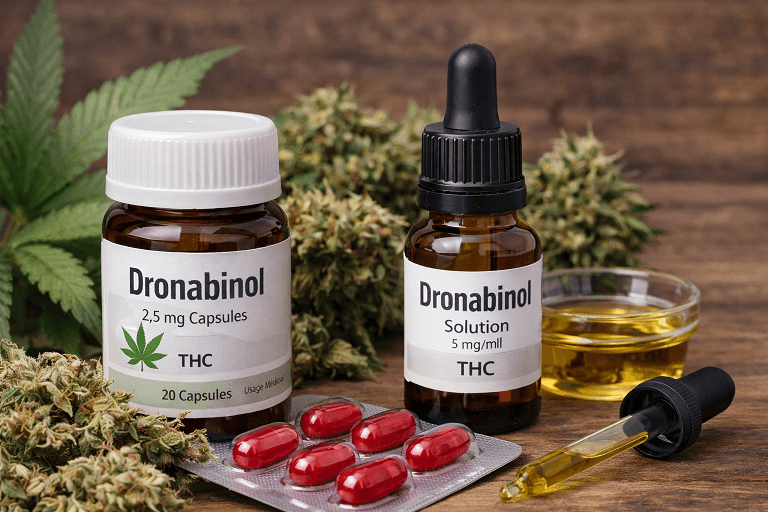
Dronabinol is often presented as a pharmaceutical alternative to cannabis, although it remains surrounded by many grey areas. Is it really THC? Why is it authorised in some countries and so difficult to access in others? And above all, who is it actually intended for? In this article, we take an in-depth look at this key molecule in medical cannabis across Europe.
What is Dronabinol?
Dronabinol is the international nonproprietary name (INN) for Δ9-tetrahydrocannabinol, better known by the abbreviation THC. It is the main psychoactive cannabinoid naturally found in the cannabis plant. The key difference from recreational or traditional therapeutic cannabis lies in its form and its framework of use. Unlike flowers or whole-plant extracts, Dronabinol is an isolated molecule, produced according to strict pharmaceutical standards. It can be synthesised in the laboratory — as is the case with Marinol®, the best-known brand name, approved by the FDA in 1985 — or extracted from the plant, but in all cases its dosage is precise, consistent and controlled. In practice, this means the patient receives an exact amount of THC, without other accompanying cannabinoids or terpenes, which clearly sets it apart from full-spectrum preparations.
How does Dronabinol work in the body?
Dronabinol exerts its effects through partial agonist activity at the CB1 and CB2 cannabinoid receptors of the endocannabinoid system. CB1 receptors, widely distributed throughout the central nervous system, mediate effects such as appetite stimulation, pain modulation and changes in emotional and cognitive processes. CB2 receptors, more prevalent in the immune system, are involved in the regulation of inflammation.
Regarding its pharmacokinetics, Dronabinol is absorbed at a rate of 90–95% after oral administration, although due to the hepatic first-pass effect and its high lipophilicity, only 10 to 20% of the dose reaches the systemic circulation. It is extensively metabolised in the liver via the CYP2C9 and CYP3A4 enzymes, and its main metabolite, 11-OH-THC, also contributes to the psychoactive effects.
Who is Dronabinol intended for?
Dronabinol is not intended for the general public or for comfort use. It is primarily aimed at patients suffering from serious or chronic conditions for whom conventional treatments have proved insufficient.
It currently has two FDA-approved indications:
- Chemotherapy-induced nausea and vomiting (CINV), in patients who do not respond adequately to conventional antiemetics.
- Anorexia associated with weight loss in HIV/AIDS patients, as an appetite stimulant.
Additionally, off-label uses are being investigated for chronic pain, particularly neuropathic pain, as well as for reducing spasticity associated with multiple sclerosis and, more recently, for obstructive sleep apnoea, although the results are not yet conclusive.
Its use is always carried out under medical supervision, with a gradual increase in dosage to limit side effects. Since THC can cause anxiety, drowsiness, dizziness, euphoria or cognitive impairment, medical monitoring is a key element of treatment. Furthermore, as a substance with abuse potential, it is classified as a controlled substance.
How is Dronabinol consumed?
Dronabinol is not smoked or vaporised. It is administered exclusively by mouth, in the form of soft gelatin capsules (available in doses of 2.5 mg, 5 mg and 10 mg) or as an oral solution. The capsules contain the active ingredient dissolved in sesame oil, a relevant detail for patients with allergies.
This method of administration means a slower onset of action compared to inhalation — typically between 30 minutes and 2 hours — but also longer-lasting effects, which can persist for several hours.
The usual dosage for appetite stimulation is 2.5 mg twice daily, one hour before lunch and dinner. For chemotherapy-induced nausea control, the dose may be adjusted according to the patient’s body surface area and can be administered 4 to 6 times a day. This requires careful dose adjustment: while inhaled cannabis allows almost immediate titration, oral Dronabinol acts for several hours, which explains the caution of medical protocols and the need for gradual titration.
Dronabinol in Europe
The European landscape of medical cannabis — and of Dronabinol in particular — is extraordinarily heterogeneous. According to a recent analysis of European regulatory frameworks, three groups of countries can be identified: those with established legislation, those operating through pilot programmes, and those that have barely begun regulating.

Dronabinol in Spain
Spain has undergone a landmark change with the approval of Real Decreto 903/2025, published in the BOE on 9 October 2025, which for the first time regulates the medicinal use of cannabis in the country through standardised magistral formulations prepared from standardised cannabis preparations.
This regulation establishes that prescriptions are restricted to specialist doctors in the hospital setting, with preparation carried out exclusively in authorised hospital pharmacy departments. Preparations must be registered with the Agencia Española de Medicamentos y Productos Sanitarios (AEMPS), which will define the specific indications in the monographs of the National Formulary. So far, the initial indications include refractory chronic pain, multiple sclerosis-related spasticity, refractory epilepsy, and chemotherapy-induced nausea and vomiting.
It is important to note that this Real Decreto regulates formulations based on standardised cannabis extracts, not synthetic cannabinoids such as Dronabinol itself. However, prior to RD 903/2025, Spain already had two authorised cannabinoid-based medicines: Sativex® (nabiximols, THC+CBD) and Epidyolex® (CBD), both for specific indications. Dronabinol as an isolated molecule remains of limited access, primarily through exceptional authorisations or compassionate use.
The Spanish contrast remains striking: while cannabis social clubs are widely known, official medical THC advances in a controlled and exclusively hospital-based manner.
Dronabinol in France
France maintains a considerably more restrictive position. Medical cannabis is in the experimental phase: a pilot programme with approximately 2,000 patients is evaluating its efficacy, although its continuation has been the subject of debate. In March 2025, the country announced measures to facilitate access to cannabis-based treatments for patients with serious illnesses, although the framework remains limited to five conditions and subject to strict medical controls.
Dronabinol is only authorised in very specific situations, often through hospital protocols or exceptional authorisations. THC remains heavily regulated and difficult to access, which considerably limits the availability of cannabinoid treatments for patients who could benefit from them. Paradoxically, France is one of the European countries with the highest prevalence of recreational cannabis use.
Dronabinol in Germany
Germany is currently the most advanced European country in terms of medical cannabis and, since April 2024, also in terms of recreational use regulation. Dronabinol is fully integrated into the healthcare system since the approval of the “Cannabis as Medicine Act” in 2017, with prescriptions available from authorised physicians and, in certain cases, reimbursed by health insurance.
German patients have access to a wide range of cannabis-based therapeutic options — including flowers, extracts and Dronabinol — making the country a benchmark in Europe. The Cannabis Act (CanG) of 2024 went a step further by allowing the possession of up to 25 grams in public spaces and home cultivation of up to three plants per adult, consolidating Germany as the most advanced European model for comprehensive cannabis regulation.
Other European countries of interest
Denmark approved the Medical Cannabis Act (L135) in May 2025, turning its seven-year pilot programme into a permanent policy within the national health system. Italy allows medical cannabis but tightened regulations on cannabis light in 2025. And Slovenia has introduced a law considered by experts to be “the most progressive in Europe” for medical cannabis.
Dronabinol and whole-plant cannabis
Although Dronabinol contains exactly the same molecule as the THC found in the cannabis plant, the perceived effects can differ significantly.
The absence of CBD, terpenes, flavonoids and other minor cannabinoids prevents what is known as the entourage effect, a concept originally proposed by Mechoulam and Ben-Shabat in 1999 suggesting that cannabis compounds act synergistically to modulate the plant’s overall effects.
However, it is important to note that the scientific evidence for the entourage effect remains a matter of debate. A review published in Frontiers in Pharmacology concluded that cannabis terpenes do not interact directly with CB1 and CB2 receptors, calling into question the most commonly cited mechanism of the entourage effect. Conversely, a more recent clinical study from Drexel University found that the combination of THC with the terpene d-limonene reduced anxiety, nervousness and paranoia, representing one of the first pieces of clinical evidence in favour of this effect.
Some patients report a more “raw”, more cerebral or more anxiety-inducing effect with isolated Dronabinol, while whole-plant extracts offer an experience perceived as more balanced and better tolerated. Rigorous comparative studies, such as that by Cooper et al. (2013), found that the differences in pain sensitivity between smoked marijuana and oral dronabinol were not significant, suggesting that the superiority of whole-plant cannabis is not as well proven as is commonly claimed.
This explains why Dronabinol works very well for certain patient profiles — particularly those who need precise and reproducible dosing — but may be less suitable for others who benefit from the phytochemical complexity of whole-plant preparations.
The key role of Dronabinol in the history of medical cannabis
Beyond its therapeutic use, Dronabinol plays a fundamental symbolic and historical role. Approved by the FDA in 1985 — first for chemotherapy-induced nausea and later in 1992 for HIV/AIDS-associated anorexia — it was for a long time the institutional gateway for THC into modern medicine.
By isolating and standardising the molecule, health authorities were able to accept what had until then been inseparably associated with a prohibited plant. This classic pharmaceutical approach — one molecule, one dose, one mechanism — made it possible to integrate THC into existing regulatory frameworks.
Today, Dronabinol perfectly illustrates the transition of cannabis, which is progressively moving from a prohibited status to that of a recognised therapeutic tool. On the international stage, it is worth noting that dronabinol and its stereoisomers are listed in Schedule II of the 1971 Convention on Psychotropic Substances, while whole-plant cannabis remains in Schedule I of the 1961 Single Convention, reflecting differentiated regulatory treatment.
This path remains uneven depending on the country, but the trend is clear: an increasing number of European jurisdictions are incorporating medical cannabis into their healthcare systems, whether through pure Dronabinol, standardised magistral formulations such as those now regulated in Spain, or comprehensive programmes like the German one.
Main sources:
- O’Donnell B., Meissner H., Gupta V. Dronabinol. StatPearls, NCBI (2023). Link
- DrugBank. Dronabinol. Link
- MedlinePlus. Dronabinol. Link
- Drugs.com. Dronabinol Uses, Side Effects & Warnings (2026). Link
- Real Decreto 903/2025, BOE. Link
- Ministerio de Sanidad de España. Press release, 7 Oct. 2025. Link
- DLA Piper. España regula por primera vez el uso medicinal del cannabis (2025). Link
- Santiago M. et al. Terpenoids From Cannabis Do Not Mediate an Entourage Effect by Acting at Cannabinoid Receptors. Frontiers in Pharmacology (2020). Link
- Drexel University. Clinical Evidence of the Entourage Effect (2024). Link
- Scientific American. Some of the Parts: Is Marijuana’s “Entourage Effect” Scientifically Valid? (2024). Link
- NCBI. Development of Cannabinoid Drugs. Link
- Plan Nacional sobre Drogas. Cannabis: International Organisations. Link
- Qualipharma. Regulatory Frameworks for Medical Cannabis in Europe. Link