

You know that feeling when your essay is basically done. And then you check the word count and realize you’re still 300 words short. It’s frustrating because you did answer the question. You made your point. You have an introduction, a few body paragraphs, and a conclusion, but it is still incomplete.
The problem usually isn’t that you need more words. You just need more depth and development of your arguments. A strong essay reaches the required length because it explains ideas fully, supports claims with evidence, and shows critical thinking. A weak essay tries to hit the word count by stretching sentences, repeating the same thought, or adding empty phrases like “this topic is very important in modern society.”
In this post, I’ll share practical ways to increase your word count ethically and naturally, with a completely different structure and new examples. You’ll also see how the JustDone Word Counter can help you track progress while you expand, so you don’t overdo it or waste time guessing.
First Tip: Check Your Gap With the JustDone Word Counter
Before you edit anything, open your draft and run it through the online Word Counter by JustDone. This step matters more than people think, because the strategy depends on how short you are.
If you’re 80-150 words under, you don’t need new paragraphs. You just need to deepen what you already wrote.
If you’re 300-500 words under, you likely need more evidence and one extra angle.
If you’re over 700 words under, your structure is probably too thin and needs more development across multiple sections.
JustDone Word Counter makes this easy because it shows not only word count, but also characters, sentences, and estimated pages. That means you can expand your essay with control instead of panic.
What Ethical Word Count Expansion Looks Like
Ethical word count growth isn’t about making sentences longer. It’s about making ideas clearer.
Every new sentence should do at least one of these things:
- Explain what you mean
- Support your claim
- Show an example
- Add reasoning
- Address another perspective
If your new sentence doesn’t do any of that, it’s probably filler.
7 Ethical Ways to Increase Word Count
Try at least one of these recommendations and you will definitely increase the number of words not writing fluff.
- Turn one sentence into a mini-paragraph
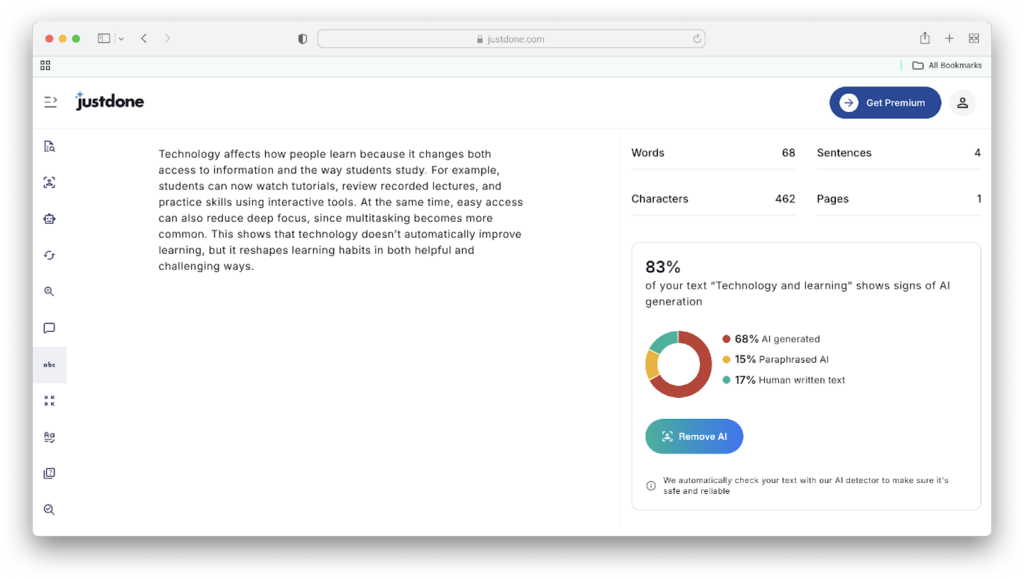
A common reason essays end up short is that students compress big ideas into one sentence and move on too fast. For example, a short version may look like this: “Technology affects how people learn.” But you can expand it to this: “Technology affects how people learn because it changes both access to information and the way students study. For example, students can now watch tutorials, review recorded lectures, and practice skills using interactive tools. At the same time, easy access can also reduce deep focus, since multitasking becomes more common. This shows that technology doesn’t automatically improve learning, but it reshapes learning habits in both helpful and challenging ways.”
JustDone Word Counter shows 68 words instead of 5. Good result, isnt it?
This method works because you’re not adding random words. You’re adding the explanation your reader expects.
- Add a “what this leads to” sentence
If you want a simple trick that adds 20-40 words per paragraph, do this: After your main point, add one sentence that explains the result.
Example: “Group projects can be stressful for students.” Add depth: “Group projects can be stressful for students because workload is often uneven, and communication problems lead to misunderstandings. As a result, students may feel frustrated or anxious, even if they are trying to do their part responsibly.”
You win 30 words for your writing as Word Counter shows.
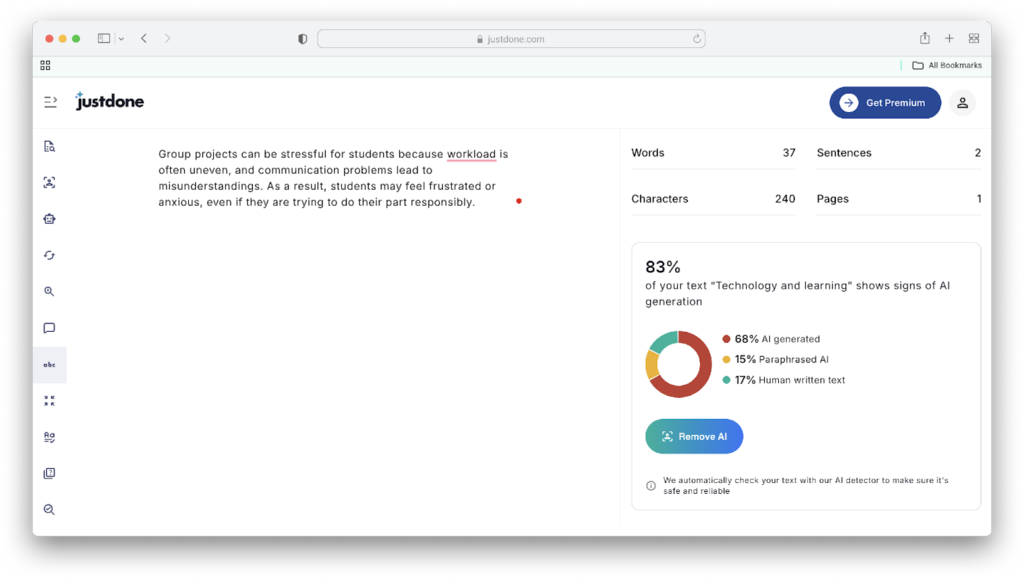
That “as a result” sentence is small, but it creates a natural cause-and-effect flow and makes your writing feel more complete.
- Use a fresh example that fits your topic
Examples add words quickly, but they also make your essay more convincing. Instead of repeating your point, show what it looks like in real life. An example topic can be time management. You may write a base paragraph: “Time management is important for academic success.” Expanded with a new example can be this: “Time management is important for academic success because deadlines often overlap, especially during exam season. For example, a student might have a presentation on Monday, a lab report due Wednesday, and a test on Friday. Without planning ahead, they may rush everything at the last minute, which lowers quality and increases stress. In contrast, a simple weekly plan can help them spread tasks out and stay more consistent.”
Notice how the example doesn’t feel like extra. It makes the point clearer and more realistic.
- Add a definition that sounds like you
One of the easiest ethical expansions is defining key terms in your own words. This is especially useful in essays about psychology, education, business, sociology, or technology.
Let’s write an argument about motivation. Like “Motivation helps students succeed.” Expand this argument like “Motivation is the internal push that helps students start tasks and keep going even when studying feels difficult or boring. It can come from personal goals, like wanting a better career, or from external pressure, like deadlines and grades. When motivation is low, students often procrastinate, avoid challenging topics, and give up faster, which affects performance over time.” This adds words and shows understanding at the same time.
- Compare two approaches instead of repeating one
If you’re short on words, comparison is a powerful way to expand without adding fluff.
You can compare:
- Traditional vs modern
- Pros vs cons
- Short-term vs long-term
- Two different solutions
This adds depth easily because you’re showing nuance, not repeating the same claim.
- Add one counterargument
This is one of the most academic ways to expand your essay because it shows critical thinking. Let’s add a counterargument and a response to the topic about remote work. “Some people argue that remote work reduces productivity because employees have more distractions at home and fewer opportunities for teamwork. This point is valid, especially for workers who struggle with focus or lack a quiet workspace. However, remote work can also increase productivity by reducing commuting time and allowing employees to work during their most focused hours.”
This tip adds 100-200 words easily, and it makes your essay sound more mature.
- Expand your evidence with analysis
If you already have quotes or data, you don’t always need more sources. You may just need better explanation. A lot of students write a quote and then move on. But try this instead: Quote – explain what it means – connect it to your argument – show why it matters. For example, a weak version sounds like this: “A study shows that sleep improves memory. This proves sleep is important.” Make this version stronger with this: “A study shows that sleep improves memory, which suggests that learning doesn’t end when students stop studying. Sleep helps the brain organize and store information, making it easier to recall during exams. This is important because many students sacrifice sleep to –study more,– but that strategy can backfire. In other words, sleeping well is not wasted time, but part of effective studying.”
The Fastest Workflow When You’re Under the Word Count
If you want a quick plan that works almost every time, use this approach:
Step 1: Check your draft in the JustDone Word Counter
Step 2: Find your shortest paragraphs (usually the weakest ones)
Step 3: Expand each paragraph using one method from this list
Step 4: Read the paragraph out loud and remove anything that sounds repetitive
Step 5: Recheck the word count and stop when you hit the requirement
This workflow prevents overwriting and helps you expand in a controlled way.
What to Avoid When Increasing Word Count
If you want your essay to sound natural and get a good grade, avoid these common mistakes:
- Repeating the same point with slightly different words
- Adding long phrases that don’t add meaning
- Dropping quotes without explaining them
- Writing generic filler sentences that could fit any topic
If your professor or editor reads your essay and feels like you’re “talking in circles,” your word count might be higher, but your score probably won’t be.
Take Word Count As a Signal, Not a Punishment
Being under the word count is annoying, but it’s also useful feedback. It often means your ideas are correct, but they’re not fully developed yet. The best way to increase word count ethically is to add depth through explanation, examples, definitions, reasoning, and counterarguments. That way, your essay becomes longer because it becomes better.
And if you want to stay in control while you edit, use the JustDone Word Counter. It keeps you focused on the exact number you need, so you can expand confidently and stop at the right moment.