
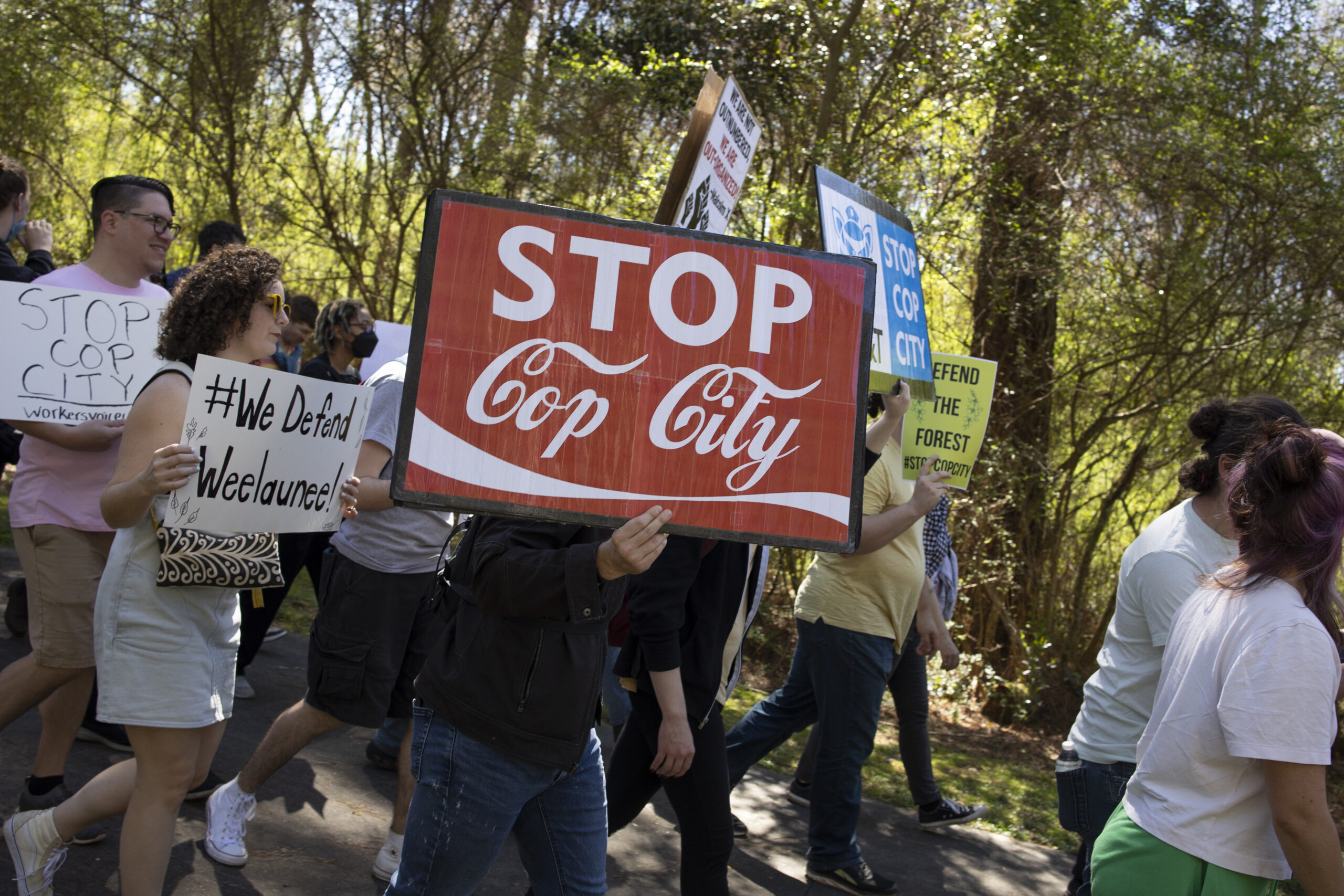

Residents in a majority-Black neighborhood in DeKalb County, Atlanta, are raising concerns about increased surveillance in their community, driven by AI-powered policing.
What Is The Atlanta Public Safety Training Center?
In April 2025, the Atlanta Public Safety Training Center (APSTC), commonly known as “Cop City,” officially opened, according to a press release. The 85-acre police training facility in DeKalb County includes horse stables, a K-9 unit center, a driving course, a six-story rescue tower, and a mock city designed to simulate real-world crisis scenarios.
According to a joint report from Capital B News and Counterstream Media, the APSTC is also equipped with over 60,000 public and private cameras. Lined with real-time crime center feeds and AI-powered cameras, the system tracks vehicle movements — capturing license plates, locations, and timestamps — and feeds the data into a searchable database shared with nearly 2,000 law enforcement agencies nationwide, per Capital B News and Counterstream Media.
The outlets note that the system also creates pathways for federal access.
“Mass surveillance in general is the issue, but AI is almost supercharging what mass surveillance can do,” said Shruti Lakshmanan of the ACLU of Georgia, per Capital B. “Before AI, surveillance footage was used to investigate situations where there was already suspicion of wrongdoing. What AI allows police departments to do is to generate suspicion.”
Tech company Flock Safety, for example, operates license plate readers that let police search for vehicles by plate, make, and model, said Lakshmanan. In newer AI pilots, law enforcement can track vehicles by descriptive details like a bumper sticker.
“Once that data is collected, it often spreads beyond its original purpose,” Lakshmanan said. “Without strong safeguards, it can be shared with federal agencies or other jurisdictions without public knowledge or consent and misused to target protesters, immigrants, communities of color, LGBTQ people, people seeking reproductive care. There’s kind of no end to how it can be misused once the city loses control.”
For 41-year-old Atlanta resident Brian Page, the APSTC makes him feel watched. He told the outlet that it invades his privacy rather than protects him. He worries the project will change the character of the neighborhood he grew up in and is now raising his daughter in.
“Just knowing the history of this country [and] the history of profiling. I do have concerns and questions about how this AI [is being used],” Page told Capital B. “I don’t trust them to have the information or collect it. I can’t understand the purpose of it.”
Environmental Concerns Around ‘Cop City’
The APSTC also replaced a once-cherished forest trail. According to Capital B News, research on the city’s tree canopy shows that replacing forest cover with pavement and rooftops can increase stormwater runoff from a typical heavy rain by up to 20%, straining aging infrastructure and worsening flooding in Black and working-class communities.
Darryl Haddock, an environmental scientist with the West Atlanta Watershed Alliance, described the city as “a poster child for income inequality and environmental racism,” according to Capital B News.
“If we keep investing without considering the needs of lower‑income Atlantans, it’ll be easy to imagine — and then see — an Atlanta where entire communities are erased,” he said.
Surveillance Cameras And Gentrification
Atlanta has reportedly experienced the fourth-highest rate of gentrification of Black neighborhoods in the country since 1980. A Harvard study found surveillance cameras are most concentrated in gentrifying neighborhoods, increasing as white residents move in, Capital B and Counterstream Media report.
“The surveillance system, the environmental issues, and the gentrification of Atlanta go hand in hand,” said community organizer Kamau Franklin, as Capital B reports. “The focus and money poured into specialized police units and cameras feels far outstripped by anything invested in housing, green space, or jobs.”
“I’m open to different types of faces in the community,” Page told Capital B. “I just hope that we can keep the core of what that community was.”
The city of Atlanta did not respond to comment requests from Capital B News and Counterstream Media, the outlets note.