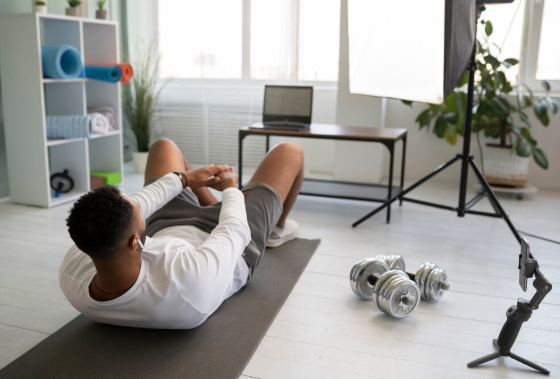
There’s a pattern that shows up again and again among high-performing professionals: they treat physical training the same way they treat building wealth. Consistently, deliberately, and with a long-term mindset that doesn’t depend on motivation to show up.
The gym membership approach works for some people. But for those running businesses, managing teams, and navigating demanding schedules, handing control of your fitness routine to a facility’s hours, location, and availability is a structural disadvantage. The people who tend to stay the most consistent are the ones who remove as many friction points as possible from the process.
Key Takeaways
- Consistent strength training improves cognitive performance, energy levels, and stress resilience, not just physical appearance.
- High-performing professionals tend to keep their fitness routines simple, equipment-light, and built around realistic daily schedules.
- A home strength setup requires far less space and investment than most people assume, and pays returns for years.
- Hex dumbbells are among the most versatile and practical pieces of home training equipment available for full-body strength work.
- The financial case for a home setup is strong. A quality set of weights is a one-time cost that quickly outpaces recurring gym fees.
Why Strength Training Specifically
Cardio gets most of the public health attention, but strength training is increasingly recognised as one of the most impactful forms of exercise for cognitive function, metabolic health, and long-term vitality. Research published across multiple journals has linked regular resistance training to improved memory, sharper focus, better sleep quality, and meaningfully lower rates of anxiety and depression.
For people in high-stakes professional environments, those benefits matter as much as the physical ones. A routine that sharpens your thinking, steadies your mood, and gives you more usable energy across the day is a direct input into performance.
The practical advantage of strength training is that meaningful results are achievable with short, focused sessions. Three 30 to 45-minute sessions per week, done consistently over months, produce significant and measurable changes in both body composition and mental sharpness.
The Problem with Depending on a Gym
Gym culture gets a lot right. Community, accountability, and access to varied equipment all have genuine value. But for people with irregular schedules and high demands on their time, the structural dependency is a real liability.
Morning meetings, early flights, late nights that push morning alarms back, a demanding quarter that makes a drive across town feel impossible. These are the exact conditions that break gym streaks. And once a streak is broken, restarting takes a different kind of effort that’s harder to summon when you’re already stretched thin.
Building a home training setup solves the access problem at the root. When the equipment is already in your space, the decision to work out stops being a logistics challenge and becomes a simple binary: do the thing, or don’t.
That cognitive simplification matters more than it sounds. Decision fatigue is real, and reducing the number of choices between you and a completed workout is a meaningful edge over time.
What a Practical Home Setup Actually Requires
The version of a home gym that shows up in aspirational content, full rubber flooring, squat racks, cable machines, multiple cardio options, is not what most productive people are actually using. The most consistent home trainers tend to have setups that would look underwhelming on camera and work extremely well in practice.
A mat, some open floor space, and a few pairs of dumbbells cover the vast majority of upper and lower body strength work without requiring a dedicated room, structural modifications, or significant ongoing cost. The key is choosing equipment that earns its footprint by serving multiple purposes.
If you want to understand more about balancing physical investment with financial discipline, these wellness routines are worth exploring, since the principles that drive consistency in fitness and wealth have more in common than most people realise.

Why Dumbbells Are the Foundation
Of all the equipment options available for home training, dumbbells remain the most practical starting point for one straightforward reason: they work for almost everything.
Compound movements like goblet squats, Romanian deadlifts, and dumbbell rows. Isolation work for shoulders, biceps, triceps, and chest. Core-stabilising exercises that challenge balance and coordination. A single pair of dumbbells, used intelligently, delivers a full-body workout that would satisfy most intermediate lifters.
The format most home trainers find most useful is the hex design. Hex dumbbells have flat-edged ends that prevent rolling when placed on the floor, which is both a safety consideration and a practical one if you’re working out on hardwood or tile rather than rubber gym flooring. Most are rubber-coated, which protects surfaces and absorbs impact noise during exercises like renegade rows or push-up variations where the dumbbell acts as a base.
The fixed-weight format also means there’s no adjustment mechanism to deal with mid-set. You pick up the pair you need, do the work, and put them down. That simplicity aligns well with the kind of streamlined, distraction-free approach that high performers tend to bring to everything else in their lives.

Building a Routine That Fits a Real Schedule
The training programs designed for competitive athletes or people with six hours a day to dedicate to recovery are not the right template for someone running a company or building a career. Effective programming for busy professionals looks different, and it needs to be built around actual available time rather than ideal conditions.
Three full-body sessions per week, spaced with at least one rest day between them, is a well-supported framework for building and maintaining strength without requiring daily gym time. Each session can be structured around four to six exercises, two to three sets each, with minimal rest between movements to keep the session compact.
Progressive overload, meaning gradually increasing the challenge over time either by adding weight or adding reps, is the mechanism that drives continuous improvement. Keeping a simple log of what you lifted and for how many reps each session takes about 90 seconds and provides the data needed to ensure you’re consistently progressing rather than maintaining.
The Financial Case for Owning Your Equipment
This is the part of the conversation that often goes undiscussed. A gym membership in a major U.S. city typically runs between $50 and $150 per month depending on the facility and location. Over five years, that’s between $3,000 and $9,000 spent on access to equipment you don’t own, in a facility that sets its own hours and cancellation terms.
A quality set of hex dumbbells, bought once, has zero recurring cost and holds its value well. Rubber hex dumbbells are durable enough to last a decade or more with basic care. The math favours ownership quickly, and for people who think in terms of assets and returns, the home training setup starts looking less like a fitness expense and more like a straightforward capital allocation.
There’s also a depreciation argument. Unlike most fitness technology, which becomes obsolete, a well-made set of weights doesn’t go out of date. The value they deliver stays constant regardless of what the fitness industry trends toward in any given year.
The Consistency Edge
The ultimate differentiator in physical training, and in most things that compound over time, is showing up more days than you don’t. Not the perfect programme. Not the best equipment. Not the optimal macros. Consistency, over long enough timelines, produces results that dwarf any other variable.
A home setup that removes travel time, operating hours, equipment availability, and the social performance pressure of a public gym is a consistency advantage. It’s the kind of structural edge that compounds quietly over years into a meaningful difference in how you look, how you feel, and how you perform.
The best time to build that setup is before you feel like you desperately need it. Like most worthwhile investments, the earlier you start, the longer the compounding has to work.
FAQ
Q: How many pairs of dumbbells do I need to start? A: Two to three pairs at varying weights covers most workout needs. A lighter pair for isolation and upper body exercises, and a heavier pair for compound lower body movements like squats and deadlifts, is a solid foundation to build from.
Q: Is strength training three times per week enough to see real results? A: For most people, yes. Three full-body sessions per week with progressive overload is sufficient to build meaningful strength and muscle over time. Consistency and gradual progression matter far more than session frequency.
Q: What makes hex dumbbells better than round dumbbells for home use? A: The flat ends prevent rolling on hard floors, which matters when you’re setting weights down between sets without a rubber gym floor underneath. The rubber coating also protects surfaces and reduces noise, both practical advantages for a home environment.
Q: How long before I see results from a home dumbbell routine? A: Most people notice changes in strength within three to four weeks. Visible changes in body composition typically take six to twelve weeks of consistent training and are supported by paying attention to nutrition alongside the training itself.
Q: Can I build serious strength with just dumbbells, or do I eventually need a barbell setup? A: Dumbbells can take most people well into intermediate strength levels. A barbell setup offers advantages at heavier loads, but the majority of people training for health, performance, and body composition never reach a point where dumbbells genuinely limit them.