
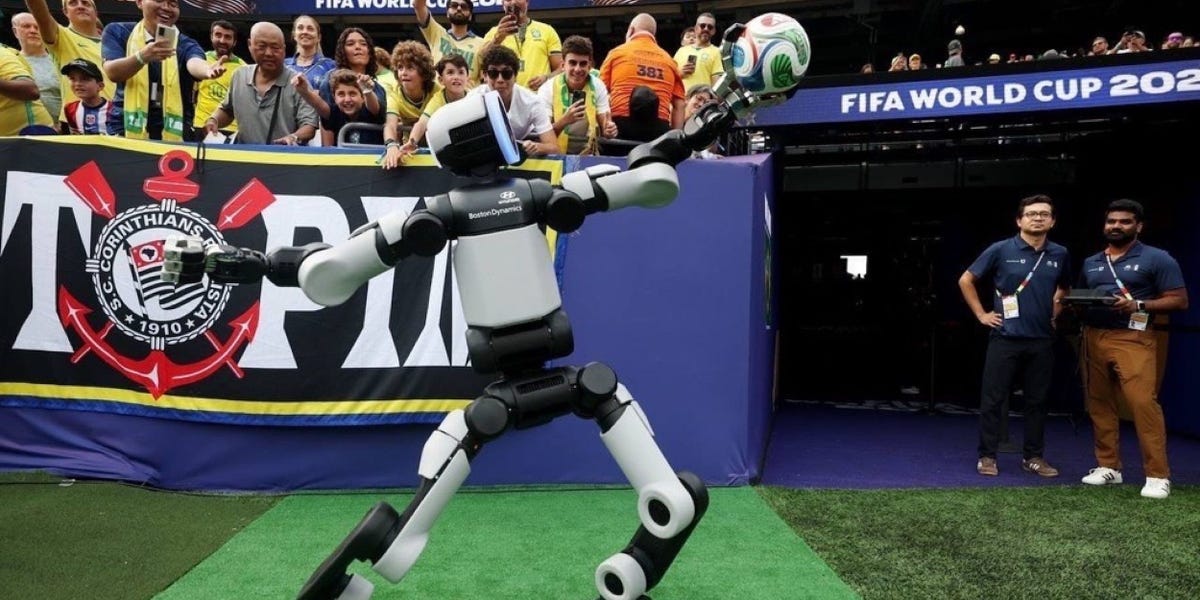

AI made its way onto the 2026 World Cup stage on Sunday, July 5, 2026, with a special appearance from Atlas, a humanoid robot developed by American robotics company Boston Dynamics, owned by Hyundai.
According to Business Insider, the ultra-flexible robot helped start the second half of the Brazil vs. Norway match by delivering the game ball to the referee before surprising fans with a recreation of Norway striker Erling Haaland’s signature goal celebration. Norway won the match 2-1.
Atlas was one of the first humanoid robots to capture global attention when Boston Dynamics introduced an early version in 2013, the outlet notes.
The newest version of Atlas, introduced in January 2026, features fully rotational joints that allow the robot’s head, torso, and limbs to rotate 360 degrees. Boston Dynamics’ former CEO Robert Playter said the company drew inspiration from the Pixar lamp when developing the robot’s movement and design, per BI.
“The world’s most dynamic humanoid robot, Atlas, is transforming enterprise applications. Built on decades of research and real-world experience, Boston Dynamics is delivering the new face of industrial automation,” the company’s website states. “Stop restructuring your workspace for your robots and start enabling flexible, predictable, and smart material handling with Atlas.”
Atlas’ World Cup appearance comes as interest in humanoid robots continues to accelerate. While the industry is still developing, Morgan Stanley estimates the humanoid robotics market will grow from $3 billion in 2025 to $28 billion by 2030, per BI.
What Atlas Can Do
Boston Dynamics designed Atlas to quickly learn new tasks and support a variety of industrial operations, including material handling and order fulfillment, the company shared in a January news release. The robot can adapt to changing environments, lift heavy loads, and operate autonomously with minimal supervision. When its battery runs low, Atlas can navigate to a charging station, replace its own battery, and return to work.
The robot can be operated autonomously, remotely by a human, or through a tablet interface, according to the release. Built for industrial environments, Atlas includes safety features such as human detection and can integrate into workflows using tools like barcode scanners and RFID technology.
“For more than 30 years, Boston Dynamics has been building some of the world’s most advanced robots,” Playter said in a statement. “This is the best robot we have ever built. Atlas is going to revolutionize the way industry works, and it marks the first step toward a long-term goal we have dreamed about since we were children — useful robots that can walk into our homes and help make our lives safer, more productive, and more fulfilling.”