
Nursing is often associated with direct patient care, but some of the profession’s most lasting influence happens away from the bedside. Every new nurse needs someone to turn complex theory into safe practice, and experienced clinicians need ongoing education as technology, treatments, and standards evolve. Nurse educators help make that possible. They prepare students, support practicing nurses, introduce new clinical practices, and strengthen the systems behind patient care. For nurses who enjoy teaching, mentoring, and improving how teams work, education can provide a career that uses clinical experience in an entirely different way.
Teaching Is Only Part of the Role
A nurse educator does far more than stand in front of a classroom.
In an academic setting, educators may design courses, teach clinical concepts, supervise practical learning, assess student progress, and help future nurses develop sound judgment. Within healthcare organizations, the focus may shift toward orientation, professional development, competency assessment, and training around new equipment or procedures.
The common thread is translation.
Healthcare knowledge can be complicated, and knowing the facts is different from being able to apply them during a demanding shift. Educators help bridge that gap by creating learning experiences that connect theory with realistic clinical situations.
That requires subject expertise, patience, communication skills, and an understanding of how different people learn.
Education and Credentials Can Shape the Career Path
Moving into nursing education may require additional academic preparation depending on the position.
Many roles expect graduate-level nursing education, particularly when teaching in academic programs or taking on advanced responsibilities. Some positions may have different requirements depending on the institution, level of instruction, specialty, and scope of work.
Professional credentials can provide another layer of development.
Understanding nurse educator certification can help nurses compare credentials designed for academic education with those connected more closely to professional development or staff education. The right option depends on where someone wants to teach and what kind of learners they expect to support.
Credentials should not be viewed as a substitute for teaching ability, but they can demonstrate formal preparation in areas such as curriculum development, learning assessment, educational methods, and professional standards.
Good Education Strengthens Patient Care
Education can feel removed from the patient room until something changes and staff needs to respond.
Imagine a healthcare organization introducing new equipment. Nurses may receive written instructions, but reading a manual is not the same as feeling confident enough to use the equipment safely during a busy shift.
An educator can build training around demonstration, supervised practice, common mistakes, troubleshooting, and follow-up assessment.
The same principle applies to medication safety, infection prevention, emergency procedures, documentation, and communication.
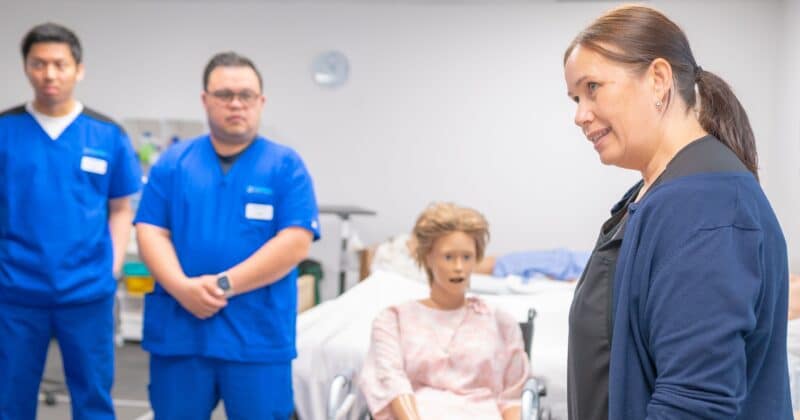
This is why simulation-based patient safety training can be such a useful part of nursing education. Practicing realistic situations allows learners to develop judgment and reinforce safe behaviors before those decisions involve an actual patient.
Effective teaching is therefore not separate from quality care. It helps create the conditions in which safer care can happen.
Nurse Educators Work in More Places Than Classrooms
Academic nursing programs are an obvious home for educators, but they represent only one part of the field.
Healthcare organizations also rely on educators to support newly hired nurses, experienced staff, specialty units, and organization-wide training initiatives. Some professionals focus on clinical education within one specialty, while others design programs that reach multiple departments.
Education roles may also appear in community health, professional organizations, healthcare training, and other settings where nurses need continuing development.
The rhythm of the work can vary considerably.
One position might involve regular classroom teaching and student assessment. Another could center on developing training resources, conducting competency sessions, coordinating orientation, and responding when clinical teams need additional education.
That variety gives nurses several ways to move into teaching without necessarily leaving healthcare practice behind completely.
Clinical Experience Still Matters
Strong educators need more than presentation skills.
Clinical experience gives teaching credibility because it helps educators understand the realities learners will eventually face. A concept that sounds straightforward in a textbook may become much harder when several patients need attention at once, documentation is waiting, and priorities are changing quickly.
Experienced nurses understand that tension.
They can bring practical examples into teaching, anticipate where learners are likely to struggle, and explain why certain procedures or communication habits matter beyond simply meeting a requirement.
That does not mean every excellent clinician automatically becomes an excellent educator.
Teaching requires its own skills. Knowing how to perform a procedure and knowing how to help someone else understand it are two different abilities.
The most effective educators usually develop both.
The Career Outlook Extends Beyond Bedside Nursing
For nurses thinking about a long-term move toward education, it helps to see teaching as a genuine professional track rather than simply an exit from bedside work.
The broader postsecondary teaching career outlook includes nursing instructors among occupations expected to see continued demand as future healthcare workers need education and preparation.
That need connects directly with a larger challenge in healthcare: every incoming generation of nurses must be trained by professionals who understand both clinical practice and education.
Experienced nurses can therefore carry their knowledge forward in a way that reaches far beyond the patients they personally treat.
One educator may influence dozens or even hundreds of nurses over the course of a career, and those nurses go on to care for thousands of patients.
The impact multiplies.
Communication Becomes a Different Kind of Clinical Skill
Nurses already spend a significant amount of time communicating.
They explain care to patients, coordinate with colleagues, give handoffs, document changes, and help families understand complicated information. Education builds on many of those abilities but uses them differently.
An educator needs to recognize when someone is confused even if that learner does not say so directly. They need to explain a concept more than one way and provide feedback that corrects mistakes without undermining confidence.
Experienced nurses can present another challenge.
Someone who has followed the same procedure for years may be less enthusiastic about changing it simply because a new policy appears. Educators need enough tact and credibility to show why the change matters and how it should work in practice.
Good teaching is rarely about talking more. Often, it is about explaining more clearly.
Technology Is Changing How Nurses Learn
Modern nursing education increasingly extends beyond printed materials and traditional lectures.
Simulation equipment, learning-management platforms, virtual training, digital assessments, and online continuing education can all play a role in professional development.
The technology itself is not the point.
A sophisticated simulation has limited value without clear learning goals. An online module is ineffective if employees complete it without retaining what they need. Educators must decide which method actually fits the skill being taught.
That makes instructional design an increasingly valuable part of the role.
Nurse educators need to think not only about what learners should know, but how they are most likely to understand, practice, remember, and apply that knowledge.
Mentoring Can Be Just as Important as Teaching
New nurses do not only need clinical information. They also need help developing confidence.
The transition from student to professional can be demanding because real healthcare rarely presents problems in the neat order found in coursework. Priorities shift, communication becomes more complicated, and decisions carry greater responsibility.
Educators can provide structure during that transition.
They may help nurses reflect on difficult situations, strengthen weak areas, and understand what competent practice looks like without expecting perfection immediately.
That support can shape how new professionals experience the workplace.
A nurse who feels prepared enough to ask questions and continue learning is in a very different position from one who feels expected to know everything from the first shift.
The Right Career for Nurses Who Want a Wider Reach
Nurse education is not simply an easier alternative to direct patient care.
It comes with its own deadlines, responsibilities, difficult conversations, changing standards, and pressure to keep programs effective. Teaching also requires continuous learning because healthcare does not stop changing once someone becomes an educator.
For the right person, however, that is exactly what makes the career interesting.
Nurses who enjoy mentoring colleagues, simplifying complex ideas, improving systems, and watching other professionals grow may find that education gives their clinical knowledge a wider reach.
The influence is less visible than providing bedside care to one patient in one moment, but it can extend much further.
By preparing the people who deliver care, nurse educators help shape what happens in countless patient rooms they may never personally enter. That is what gives the role its real significance: teaching one professional can improve the care experienced by many others.