
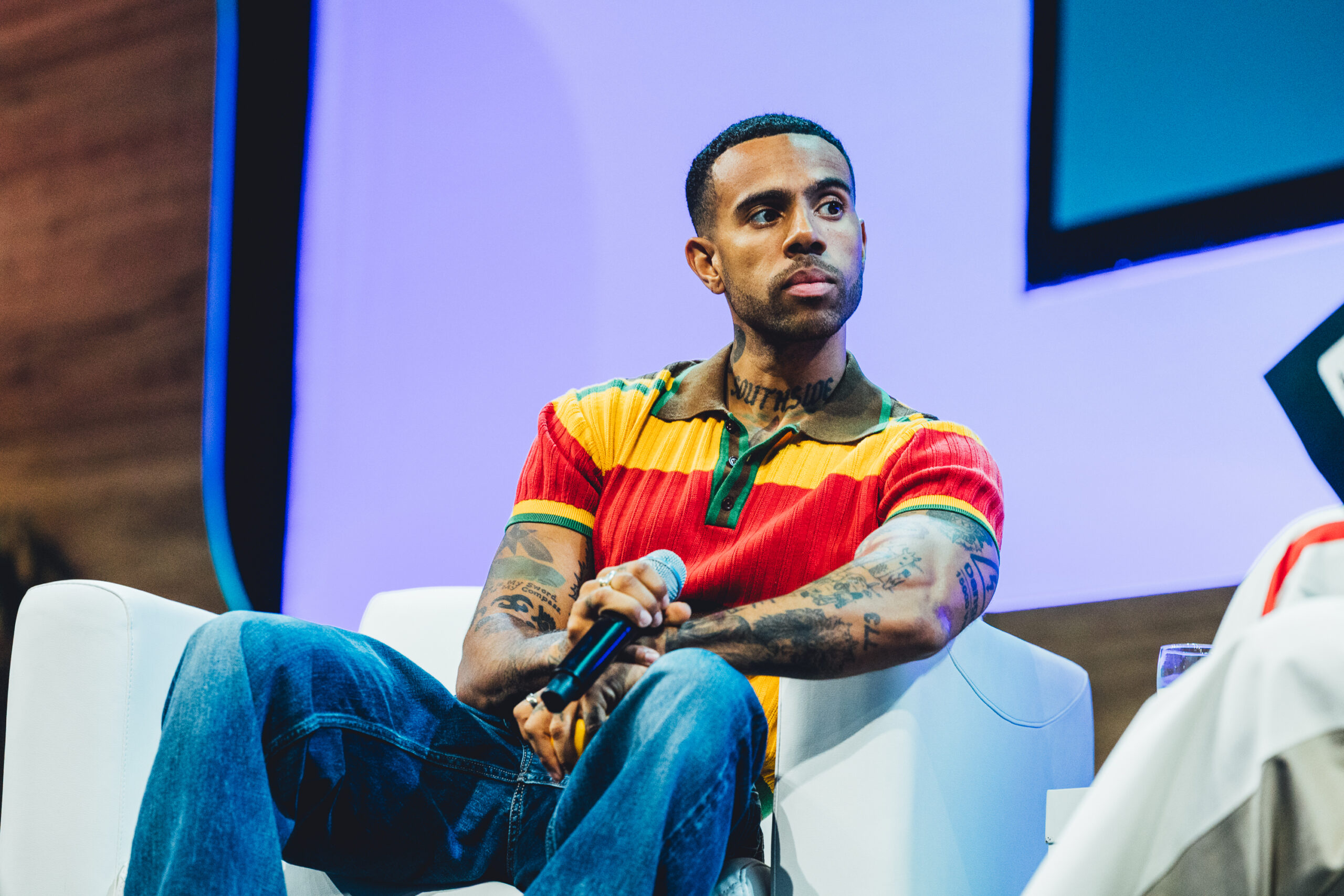
Multihyphenate Vic Mensa admits AI is a “complex double-edged blade.”
Mensa, who wears many hats, including Ghanaian-American musician, actor, filmmaker, and founder, took the Main Stage at the 2026 AFROTECH™ Conference on Thursday, Nov. 5. He boldly described AI as the music industry’s “final form” of the “exploitation of Black people,” arguing that it represents another attempt by the industry to create Black music without Black artists’ involvement.
“They’ve been trying to find a way to make Black music without involving us for a long time,” he told the audience during his session, “Sound Of Change,” moderated by Simone Tyler, SVP, AfroTech and Live Events, Blavity Inc. “You listen to all forms of pop music, not only do they all come from Black music and from the music of the Black church, but also now they’ve just adopted the exact styles of like things UGK was doing 20 years ago. The drum sounds that Pimp C was using 20 years ago is now what you’ll hear on like a Sabrina Carpenter song.”
That’s not to say Mensa is anti-AI. He also acknowledged it can be used as a “wonderful tool creatively,” giving examples like generating visual concepts that may not fit an artist’s budget, flipping a sample that wouldn’t require clearance, or improving overall efficiency.
“Nothing can ever replace the human element of creativity … I do think that there’s a great divide between using AI as a creative tool in your arsenal next to many other creative tools and just approaching it from a place of seeking to replace human beings,” he said.
Mensa also added that without collective involvement, AI will continue to be “weaponized against us.” He urged the Black community to stay at the forefront of creating its own AI systems and technologies that consider the community. He also encouraged innovators to be mindful of where data centers are being built, listing locations such as Memphis, TN, or Gary, IN, with predominantly Black communities.
“It’s not going to stop. AI is not going anywhere. If we choose to conscientiously object and say, ‘We’re not going to participate,’ it’s not just going to stop moving. It’s just going to move without us. So I do think it’s important for Black people to be trained in these models,” he explained.