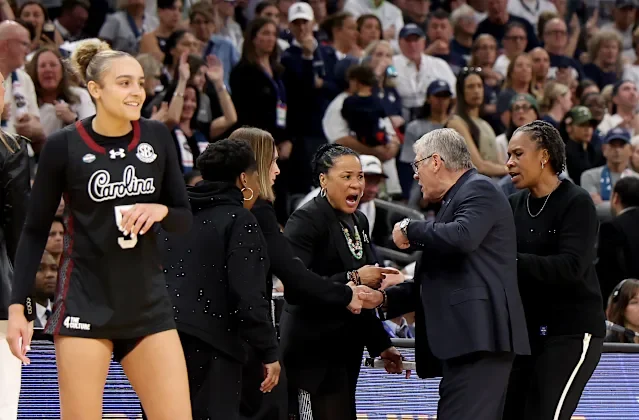
Geno Auriemma directly apologized to South Carolina coach Dawn Staley on Tuesday evening, saying he “lost myself” during a heated postgame confrontation after his UConn team’s 62-48 Final Four loss. This was his second statement in four days, but the first to address Staley by name—a meaningful pivot that signals genuine accountability from the legendary coach. Yet the apology’s significance extends beyond the moment: it reflects the principled leadership Staley has modeled for years when confronting racism and institutional inequity in college sports.
The Apology: From Initial Deflection to Full Accountability
Auriemma’s second statement marks a stark contrast to his first. In his initial April 4 apology, released the day after the Final Four semifinal, he apologized to South Carolina’s “staff and team” but notably omitted Staley’s name—a whitewashing that drew criticism for appearing incomplete and impersonal.
By Tuesday night, after speaking directly with Staley that morning, his words shifted entirely:
“This morning, Dawn Staley and I spoke about our interaction after the game last Friday. **I apologized to Dawn, her staff and her team. I’ve lost more games in the Final Four than any coach in history. But Friday I lost something more important. I lost myself.**
Those who know me know I have nothing but respect and admiration for the game and the coaches who coach it. **Dawn and her team deserved to win, and they deserved better from me.**
Women’s basketball deserved better. My university, my athletes, my former players and our fans deserved better. **Dawn and I have agreed to move on, and we hope the focus will shift back to the growth in women’s basketball. The game deserves it.**”
The language reveals a man reckoning not just with losing, but with losing his composure. Auriemma acknowledged that his behavior violated his own stated values, and by extension, the standards of a sport he claims to respect. This is accountability that moves beyond surface-level damage control.
Staley’s Response: Grace Built on a Decade of Principled Leadership
Staley’s response was equally measured, but it carried the weight of someone who has long understood the difference between individual failures and systemic ones. Earlier that same Tuesday, she released her own statement:
“I spoke with Geno, and I want to be clear — I have a great deal of respect for him and what he’s meant to this game. **One moment doesn’t define a career, and it doesn’t change the impact he’s had on growing women’s basketball.**”
This grace was not born in a vacuum. It reflects a leader who has spent years wrestling with race, accountability, and what true growth requires.
Staley’s Racial Justice Leadership: A Six-Year Record
The George Floyd Statement (2020)
In June 2020, as the nation reeled from George Floyd’s murder, Staley released a searing personal reflection that revealed why she could extend grace to Auriemma while maintaining fierce standards for institutional racism. She wrote from lived experience:
“My grandma was so scared of what that store owner might do after my mom told her what had happened that she packed my mom’s bags and sent her to live with family up north.” Staley’s mother had been sent away from South Carolina at age 13 because her grandmother feared for her safety over a simple disagreement with a white store owner during segregation.
She continued: “Black people are tired. It gets worse and worse and worse. It’s like, What do I do now?”
Yet Staley’s statement wasn’t paralysis—it was a call to structural change. She spoke about implementing mandatory diversity courses for incoming South Carolina freshmen, calling for representation in athletic departments, and mobilizing the vote. She named white privilege directly: “When you are privileged—when you are the privileged race, you don’t have to think about what we think about daily.”
Most tellingly, she distinguished between what systemic racism demands and what individual growth requires:
“White players and coaches can expose us to how they look at things, how they see the world, how they feel about things. And black players and coaches can expose them to what’s happening in our world. I mean, that’s the way the world’s supposed to operate. **That’s how we build unity and collective power.**”
This framework—creating space for discomfort, dialogue, and transformation—appears to be exactly what Staley offered Auriemma.
The BYU Cancellation (2022)
But Staley has also shown she won’t hesitate to impose institutional consequences for racist behavior. In September 2022, she canceled South Carolina’s home-and-home basketball series with Brigham Young University after a racial slur incident at a BYU volleyball match, where Duke player Rachel Richardson, a Black athlete, reported hearing racial epithets from fans.
Staley’s statement was unequivocal: “As a head coach, my job is to do what’s best for my players and staff. The incident at BYU has led me to reevaluate our home-and-home, and I don’t feel that this is the right time for us to engage in this series.”
This decision reveals critical context: Staley distinguishes between institutional failure and individual accountability. BYU’s systems failed to prevent racist fan behavior—that demanded consequence. Auriemma’s personal outburst, followed by genuine contrition, demanded accountability but also an opening for growth.
Broader Advocacy (2020-2026)
In 2020, Staley participated in a WBCA panel on race alongside Auriemma himself, Notre Dame’s Muffet McGraw, and former coach Carolyn Peck. She spoke then about the need for coaches to “get out of their comfort zone” and have conversations about race. She acknowledged being “one of two black head coaches” at South Carolina and called for bridging the gap within athletic departments.
Her advocacy has been consistent: structural change requires uncomfortable conversations, but sustainable change requires people—especially those in power—to do the internal work of confronting bias and acknowledging their own limitations.
What Auriemma’s Apology Signals
The confrontation itself was revealing. In the final seconds of South Carolina’s victory, Auriemma approached Staley with apparent anger over a pregame handshake dispute (he claimed he waited three minutes; footage showed they did shake hands). He didn’t regret his postgame comments criticizing South Carolina’s physicality, initially suggesting Staley “rants and raves” at officials.
His evolution—from defensive justification to genuine apology—matters. It suggests that either Auriemma listened to criticism or took Staley’s response seriously enough to reckon with his behavior. Either way, he chose accountability over ego.
The two coaches have now agreed to move forward, and both programs are scheduled to meet again on November 24 in the Basketball Hall of Fame Women’s Showcase at Mohegan Sun Arena, as well as in the 2027 Ally Tipoff Event.
The Larger Lesson: Accountability as Leadership
What makes this moment significant is not that conflict occurred—sports are competitive, emotions run high, and mistakes happen. What matters is what happened next. Staley’s six-year record shows she demands institutional accountability (BYU) while creating space for individual transformation (Auriemma).
She has articulated, again and again, that change happens when people in power—especially white people in power—acknowledge their blind spots and listen. She has modeled this through mandatory diversity training, advocacy for Black leadership in athletics, and voting rights mobilization.
Her grace toward Auriemma is not weakness; it is the fulfillment of a promise she made in 2020: to build unity and collective power through uncomfortable conversations and genuine growth.
As women’s basketball continues to elevate itself nationally, this moment—where a legendary coach acknowledged he lost himself, and a principled leader accepted his apology—sends a clear message: the game deserves better from everyone, and better is possible when people are willing to do the work.