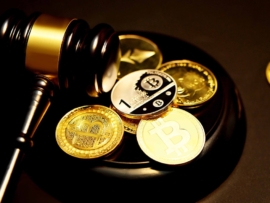
Crime and cryptocurrency often seem to be connected.
Do Kwon was sentenced to 15 years in prison for orchestrating one of crypto’s most devastating collapses. The Terraform Labs founder’s dramatic fall from grace culminated in a Manhattan courtroom where U.S. District Judge Paul Engelmayer delivered a sentence that obliterated $40 billion in investor funds and triggered the brutal 2022 “crypto winter.”
Judge Engelmayer called Kwon’s scheme “a fraud of epic generational scale” and rejected both the government’s 12-year recommendation as “unreasonably lenient” and the defense team’s plea for just five years as “utterly unthinkable and wildly unreasonable.” The 15-year sentence exceeded all expectations, sending a clear deterrent message to the crypto industry that innovation cannot shield fraudsters from justice.
From crypto celebrity to convicted felon
Back in 2019, Do Kwon was crypto’s golden boy. Featured on Forbes’ 30 under 30 Asia list six years ago, the 34-year-old’s Terraform ecosystem commanded a market value exceeding $50 billion by spring of 2022. The Stanford graduate created TerraUSD (UST), marketed as a revolutionary “stablecoin” that would maintain its $1 peg through algorithmic mechanisms rather than traditional backing assets.
Alongside its sister token LUNA, Kwon successfully marketed them as the next big thing in crypto, attracting billions in investments and global hype. But beneath the surface, a different story was unfolding. Court documents revealed that UST’s stability relied on secret trading support rather than the “self-sustaining algorithms” Kwon publicly promoted.
Behind the scenes, he had struck deals with trading firms to artificially prop up prices, creating what experts later called “a glorified pyramid scheme.” What investors believed was cutting-edge algorithmic innovation was actually an elaborate fraud designed to deceive them about the project’s fundamental risks and stability mechanisms.
When $40 billion vanished in 72 hours
The fantasy unraveled spectacularly in May 2022. TerraUSD and Luna went into a death spiral over two and a half years ago when large holders began selling UST in bulk, causing it to slip from its dollar peg. What followed was pure panic—a sell-off that drove both tokens practically to zero within days, wiping out approximately $50 billion in market value in just 72 hours.
The ripple effects were catastrophic and far-reaching. The Terra collapse triggered a cascade of crises that swept through cryptocurrency markets two and a half years ago, helping ignite the prolonged bear market that became known as the “crypto winter.” Companies like Celsius and others fell like dominoes, decimating investor savings across the globe and fundamentally reshaping public trust in cryptocurrency investments.
Judge Engelmayer emphasized yesterday that Kwon maintained an “almost mystical hold” over investors while causing incalculable “human wreckage” through four years of public lies to the market. Victims testified about losing life savings, contemplating suicide, and watching charitable organizations collapse due to the devastating financial losses.
The international manhunt that ended in Montenegro
When the Terra ecosystem began crashing down in May 2022, Kwon didn’t stick around to face accountability. He left South Korea before the collapse and spent months evading international law enforcement, fleeing through Singapore, Dubai, and Serbia while carrying forged documents.
Justice finally caught up nearly two years ago. Kwon was arrested in March 2023 at the airport in Podgorica, Montenegro, attempting to board a plane to the UAE while carrying a fake Costa Rican passport. After nearly two years of legal battles and detention in Montenegro—including periods of solitary confinement—he was extradited to the US last December.
Kwon pleaded guilty four months ago to two counts of wire fraud and conspiracy, finally admitting his role in the massive deception. In his pre-sentencing statement, he acknowledged that “blame should be pointed at me for everyone’s suffering,” marking a stark contrast from his defiant public persona during Terraform’s height.
Justice served
Judge Engelmayer made clear that Kwon’s crimes demanded serious consequences far beyond what prosecutors and defense attorneys recommended. The judge emphasized that a lighter sentence would send the wrong message, stating that “others must be deterred” and that “people are watching this” as the crypto industry grapples with accountability.
Kwon will receive credit for his 17 months in Montenegro custody plus time spent in US detention. He’s also been ordered to forfeit over $19 million in proceeds from his schemes, representing just a fraction of the massive losses inflicted on investors worldwide.
But his legal troubles are far from over. Prosecutors indicated they won’t oppose Kwon serving the second half of his sentence in South Korea, where he faces additional charges that could carry a 40-year sentence. The global nature of his crimes means he’ll be paying the price for years to come, potentially spending decades behind bars across multiple jurisdictions.
This landmark case sends a powerful message to the crypto industry: innovation doesn’t excuse fraud, and the consequences for deceiving investors can be severe and lasting. For the thousands of victims who lost their life savings, the sentencing represents at least some measure of justice in one of crypto’s darkest chapters—though many will spend years recovering from the financial devastation Kwon’s deception caused.
If that news hasn’t put you off crypto, this glossary at TechRepublic Premium will help you understand the concepts.