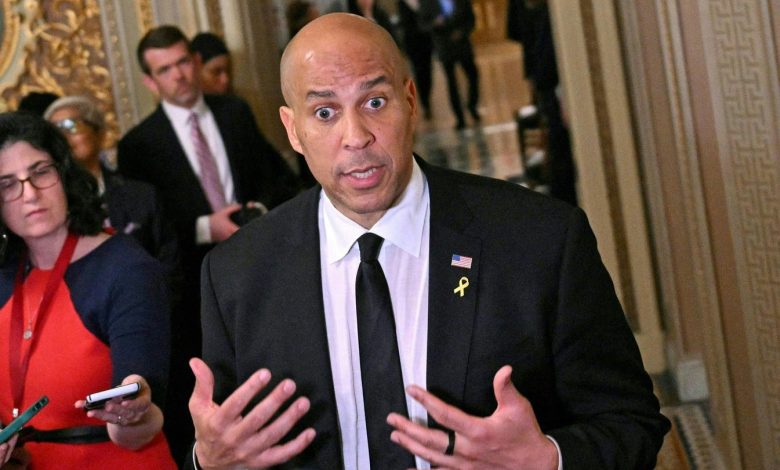

U.S. Senator Cory Booker (D-NJ) declares the initial bipartisan agreement between Republicans and Democrats did not make it into the final bill reviewed for markup by the Senate Agriculture Committee. The Dems unanimously voted against the bill, resulting in a narrow 12-11 vote that did move the legislation to the full Senate.
AFP via Getty Images
Senate Democrats accused Republicans of walking away from months of bipartisan negotiations as a crypto market structure bill was considered in the Senate Agriculture Committee during a business meeting. The panel ultimately voted to advance the sweeping digital assets bill on a 12–11 party‑line vote with no Democratic support.
A central Democratic objection is the intersection of ethics and crypto policy at a time when President Donald Trump and members of his family have embraced digital asset ventures and promotion. Senator Cory Booker (D‑N.J.) charged that the president is “grifting on crypto himself” and said it is “ridiculous” that a president and his family who have, in his telling, made “billions of dollars off this industry” are, at the same time, trying to shape its regulatory framework “without the kind of ethics that would prevent this kind of gross corruption in our country that would undermine our nation’s democracy.” He argued that the legislation must incorporate explicit ethics provisions and conflict‑of‑interest rules to help restore public trust.
Other Democrats pressed similar themes. Sen. Amy Klobuchar (D‑Minn.), the committee’s Democratic lead, underscored that “the bill before us today does not have bipartisan agreement” and said lawmakers are “not quite done yet,” pointing to prior progress on consumer protections, conflicts of interest and clear “rules of the road.” Chairman John Boozman (R‑Ark.), who successfully led the bill out of committee, noted that the bill itself could be amended later through a manager’s amendment or other tools, indicating his willingness to still work with Senate Democrats on the bill. During the markup, however, Boozman also argued that the legislation is about crypto market structure, not ethics, and that ethics questions are beyond the Agriculture Committee’s jurisdiction.
Several Democrats focused on the Commodity Futures Trading Commission itself. Klobuchar argued, “We can’t give the CFTC this broad new authority when it only has one Republican member,” warning about perceptions of the agency’s independence while its five‑member commission is not fully staffed. She and others called for at least two Democratic commissioners alongside the current CFTC chair, Mike Selig. Senator Elissa Slotkin (D‑Mich.) also noted Selig was openly pro‑crypto to the committee during his confirmation, saying it would be important to see a fully balanced and bipartisan commission to help implement the bill appropriately once passed.
Concerns also extended to national security and illicit finance. Senator Ben Ray Luján (D‑N.M.) took aim at decentralized finance, or DeFi, saying, “We keep talking about this thing called DeFi. Go and have a town hall and talk to your constituents about DeFi and see how many of them are going to be able to talk about it with clarity.” He added that “there are loopholes that terrorists and cartels are using today that the United States knows about,” calling the situation frightening and insisting any final framework must address those risks.
Democrats such as Senator Adam Schiff (D‑Calif.) and Slotkin said they support establishing clear rules and keeping the industry in the United States but want explicit ethics language and strong conflict‑of‑interest protections added before they can back the package. Schiff argued that the 12–11 committee vote is not representative of how close lawmakers actually are on policy, saying the near‑party‑line tally masks substantial narrowing of the gap on market‑structure questions. Slotkin, who also backed moving forward on a strong framework, focused heavily on the national‑security picture, warning that bitcoin is often the payment method when a hospital faces ransomware and that funds can be funneled to China, Russia and North Korea