Senators Accuse Todd Blanche of “Glaring” Crypto Conflict, Cite ProPublica Report — ProPublica

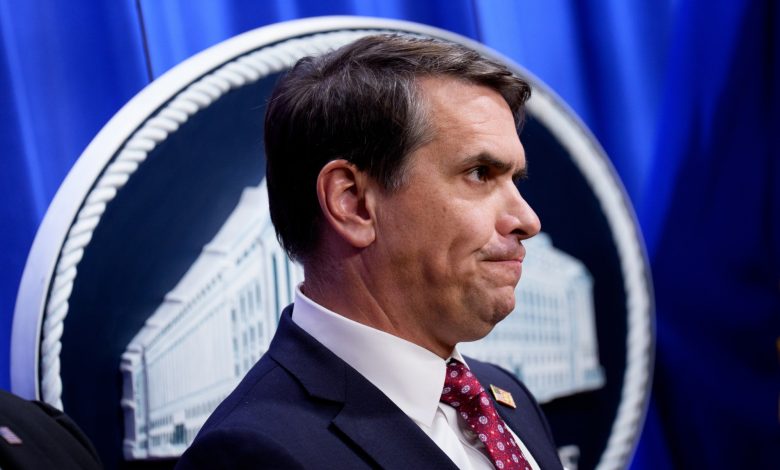
Six senators accused Deputy Attorney General Todd Blanche this week of having a conflict of interest when he shut down investigations into crypto companies, dealers and exchanges and eliminated an enforcement team dedicated to looking for crypto-related fraud and money-laundering schemes.
A letter written by Democratic Sens. Elizabeth Warren, Dick Durbin and Mazie Hirono and signed by Sens. Sheldon Whitehouse, Christopher Coons and Richard Blumenthal cited a ProPublica investigation that revealed Blanche owned at least $159,000 worth of crypto-related assets when he ordered an end to the work.
Durbin, Hirono, Whitehouse, Coons and Blumenthal serve on the Senate Judiciary Committee, which oversees the Justice Department.
The same senators previously sent a letter to Blanche raising concerns that his actions would help President Donald Trump’s financial interests in cryptocurrency. In their letter sent on Wednesday, they said Blanche’s actions appeared to violate the federal conflict of interest law.
“Last year, we asked for the rationale behind your puzzling decision to scale back the Department of Justice’s (DOJ) cryptocurrency enforcement efforts and urged you to reconsider. We write now in light of recent reporting that you held substantial amounts of cryptocurrency at the time you made this decision,” the senators wrote. “At the very least, you had a glaring conflict of interest and should have recused yourself.”
Blanche, the second-highest-ranking official at the Justice Department, signed an ethics agreement in February promising to dump his cryptocurrency within 90 days of his confirmation and not to participate in any matter that could have a “direct and predictable effect on my financial interests in the virtual currency” until his bitcoin and other crypto-related products were sold.
But on April 7, before he divested, he issued a memo titled “Ending Regulation by Prosecution” that halted investigations launched under President Joe Biden. In the memo, Blanche condemned the Biden Justice Department’s tough approach toward crypto as “a reckless strategy of regulation by prosecution, which was ill conceived and poorly executed.” The memo disbanded the agency’s National Cryptocurrency Enforcement Team, which had won several high-profile crypto-related convictions. Blanche said the agency would instead target only the terrorists and drug traffickers who illicitly used crypto, not the platforms that hosted them.
Days later, the six senators urged Blanche to reconsider, contending that his decision would otherwise help support sanctions evasion, drug trafficking, scams and child exploitation.
In their latest letter, they said their concerns had been realized. They cited an independent report that found there was a surge in illicit cryptocurrency activities in 2025, including crimes tied to money laundering and human trafficking. They also questioned Blanche’s reasons for the policy shift.
“Certainly, President Trump’s financial interests seem to have motivated some of his pardons of criminals convicted of cryptocurrency-related crimes,” their letter stated. “But the fact that you held substantial amounts of cryptocurrency at the time you made this decision calls into question your own motivations.”
A Justice Department spokesperson told ProPublica last week that Blanche’s crypto orders were “appropriately flagged, addressed and cleared in advance.” She did not elaborate or respond to questions asking who cleared his actions. The department did not respond this week to requests for comment about the senators’ criticism.
In this week’s letter, the six Democratic senators issued a series of questions demanding details about how and when Blanche’s actions were cleared and by whom.
They also asked Blanche to, no later than Feb. 11, provide any written determination he received about the legality of his crypto enforcement action; all his communications with ethics and Justice Department officials about the issue; and any communications he had with the crypto industry prior to issuing his April memo.
Their demands come approximately a week after the Campaign Legal Center, a nonpartisan government watchdog group, asked the Justice Department’s inspector general to investigate Blanche. Kedric Payne, the group’s general counsel and senior director of ethics, alleged that Blanche’s orders violated the law because they benefited the industry broadly, including his own investments. Payne estimated that the value of Blanche’s bitcoin holdings alone rose by 34%, to $105,881.53, between when he issued the memo and when he divested. At the time he issued the memo, Blanche also held investments in several other cryptocurrencies, including Solana and Ethereum, and stock holdings in Coinbase.
Under the federal conflicts-of-interest statute, government officials are forbidden from taking part in a “particular matter” that can financially benefit them or their immediate family unless they have a special waiver from the government. The penalties range from up to one year in jail or a civil fine of up to $50,000 all the way to as much as five years in prison if someone willfully violates the law.
“The public has a right to know that decisions are being made in the public’s best interest and not to benefit a government employee’s financial interests,” Payne wrote in his complaint to the inspector general.
Blanche, a former federal prosecutor for the Southern District of New York, was Trump’s lead attorney in the Manhattan trial that resulted in his being convicted of 34 felonies stemming from a hush-money payment to a porn actress, Stormy Daniels. Blanche also defended Trump against criminal charges accusing him of conspiring to subvert the 2020 election and retaining highly classified documents. (Those two cases were dropped after Trump was reelected president.)
Payne’s group expanded its investigation request on Wednesday, asking the Office of Government Ethics and the Justice Department’s ethics officer to look into whether Blanche violated his ethics agreement, the federal conflicts-of-interest statute and the federal law prohibiting false statements on compliance forms.