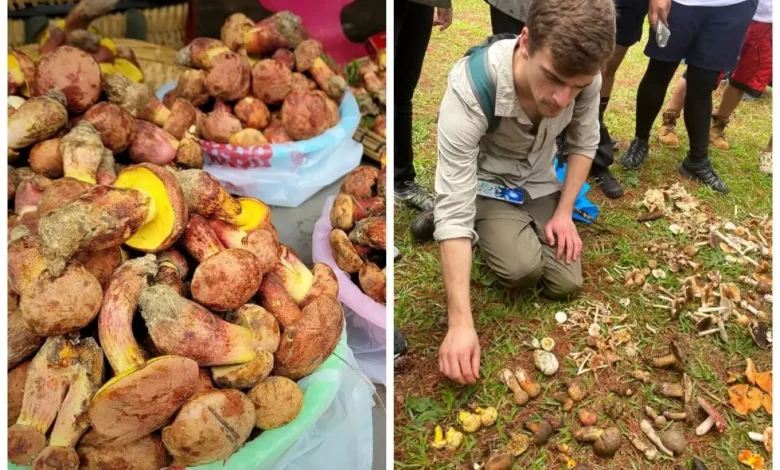
Tiny beings dwelling in the deepest parts of forests, visible only to the most observant. Mischievous and playful by nature, always inclined towards trickery and deceit. This description probably rings a bell — they’re commonly known as goblins, and a mushroom has recently been found that reveals them. Well, recently is a bit of a stretch… but with our strong Western scientific lens, everything we didn’t know about on this side of the planet counts as a recent discovery — just ask our American friends — since in China, these are mushrooms that have been used since time immemorial.
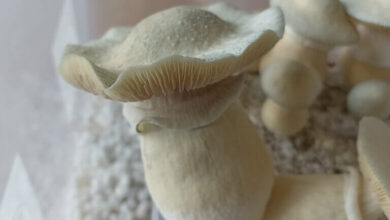
The scientific name of this strange mushroom is Lanmaoa Asiatica, and in Yunnan, China, it is commonly called jian-shou-qing, due to its famous blue bruising when touched — and no, it doesn’t belong to the Psilocybe family.
If you’re somewhat familiar with the world of psychedelic substances, you’re probably thinking this is a biased article, that this mushroom surely contains psilocybin, muscimol, or even lysergic acid, and that you’ve fallen for textbook clickbait. To be honest, that was the first thing the author of this article thought when the internet started filling up with headlines about it, but nothing could be further from the truth.
Timeline of Lanmaoa asiatica
This mushroom, scientifically named Lanmaoa Asiatica in 2014, has been part of Chinese folk knowledge for millennia: the oldest text describing mushrooms that, when poorly cooked, cause visions of “Xiao ren ren” (translated as little people), comes from a Taoist text from the 3rd century. It reports the following:
“If consumed raw, it allows the person to ‘see a small person’ and ‘achieve transcendence immediately’.”
And the strangest thing of all is that, since that very first text, the same visions or hallucinations have been reported. We’re accustomed to psychedelics like psilocybin or LSD, or even muscimol as previously mentioned, which produce similar effects across users but with different visions and accounts for each person. That’s not the case here — everyone describes the same effects: visions of little men.
It wasn’t until the 1930s-50s that the first reports from explorers describing this phenomenon in Papua appeared. These reports reached the right hands — a certain Gordon Wasson. This banker-turned-mycologist was fresh from the excitement of introducing Psilocybe Cubensis to Western society through María Sabina, and he ventured into the world of the so-called jian-shou-qing.
It was in 1963 that this 65-year-old adventurer set off on his journey to Papua, with the goal of discovering the compound responsible for these strange hallucinations. He managed to collect samples and sent them for analysis to Albert Hoffman‘s laboratory, but they failed to find any known alkaloid. Indeed, this great duo of psychedelia — the greatest, one might say — could not unravel the mystery.

1991. This is the year when cases of Lilliputian hallucinations began to be formally recorded with increasing frequency in regional hospitals in Yunnan, China, following the consumption of certain blue-bruising mushrooms. This brought the topic back into the spotlight, with local mycologists realising that dozens of mixed species were hiding under the name jian-shou-qing. But it wasn’t until 2014 that two mycologists published the definitive scientific description in the journal Fungal Diversity. They created a new genus: Lanmaoa.
In the eyes of the general public, however, it was just as invisible as before; apart from the curious few who had tried it, nobody was aware of this mushroom’s existence — at least until an event that would change everything: the viral phenomenon.
The former US Secretary of the Treasury visited Beijing in 2023 and recounted her encounter with these mushrooms: “I was with a large group of people who organised the dinner and ordered the food. There was a delicious mushroom dish. I didn’t know those mushrooms had hallucinogenic properties… I found out afterwards.” As she went on to explain, she didn’t experience any of these effects, since the mushrooms had been cooked properly, but the headline went around the world.
Once these types of mushrooms went viral, institutions like the Natural History Museum of Utah and laboratories in China launched advanced spectrometry projects confirming their zero psilocybin content, and consequently, deepening the mystery that persists to this day.
Three continents, one and the same story
If the Taoist text from the 3rd century was already strange, wait until you hear this.
In Papua New Guinea, local communities have been consuming a wild mushroom they call nonda for generations. In the Cordillera of the northern Philippines, indigenous peoples have sedesdem, and they call the little figures they see ansisit. Three cultures separated by thousands of kilometres, with no contact between them, independently describing the exact same thing: tiny people, dressed in colourful clothing, parading across surfaces, climbing furniture, sneaking under doors.

This rules out the cultural construction hypothesis. The Chinese didn’t invent the myth and have it spread: each culture arrived at the same conclusion independently. The basis is chemical and neurological, not folkloric.
And note that none of these peoples were deliberately seeking the psychoactive effect. These mushrooms have always been consumed as food, valued for their umami flavour. The visions were an unexpected side effect when cooking was insufficient. Nothing to do with the ritual or recreational use we associate with classic psychedelics.
Unravelling the mystery of Lanmaoa Asiatica, or at least trying to
Every good story needs a slightly mad protagonist, and this one has one: Colin Domnauer, a researcher at the University of Utah and the Natural History Museum of Utah. This man heard about Lanmaoa asiatica as a student and, in his own words, the idea that a mushroom could trigger fairy-tale visions seemed so outlandish that he couldn’t help but become obsessed.
And when we say obsessed, we mean it. In 2024, he travelled to the Philippines after learning that reports of a mushroom with the same effects had surfaced there too. He collected samples, analysed them genetically and — bingo: it was exactly the same species as the Chinese one, although slightly different in appearance — smaller and pinkish, compared to the reddish hue of its continental counterpart. Nature doing what it does best: trolling us. In December 2025, Domnauer’s team completed the circle that Wasson had started sixty years earlier by travelling to Papua New Guinea to search for the same samples that Wasson had been unable to decipher.
The phantom active compound: what do we know about it?
This is where things get truly exciting for chemistry geeks — and we know there are quite a few of those at Alchimia.
What Hoffman’s analyses already hinted at in the 1960s, modern spectrometry has confirmed: there is no known psychoactive compound. Zero. Nothing. The mushroom, in theory, shouldn’t get anyone high. And yet, every mushroom season — from June to August — a single hospital in Yunnan treats hundreds of cases of Lilliputian hallucinations.
What we do know is that the responsible compound — whatever it may be — is thermolabile: it breaks down with heat. That’s why, in Yunnan’s mushroom hot pot restaurants, the waiters set a 15-minute timer and calmly warn you: “don’t eat until the alarm goes off, or you might see little people.” Just like that — as casually as someone telling you your coffee is hot. In fact, the local restaurants have developed an entire cooking and serving protocol that includes a ban on pairing the dish with alcohol.
Another key detail: the effects are unusually long-lasting. We’re talking 12 to 24 hours, with some cases requiring hospitalisation for up to a week. Nothing like the 4-6 hours of a psilocybin trip. Domnauer himself, despite years of researching this mushroom, admits he still hasn’t dared to try it raw due to the duration and potential side effects — delirium, prolonged dizziness. When the researcher doesn’t dare, that tells you something.
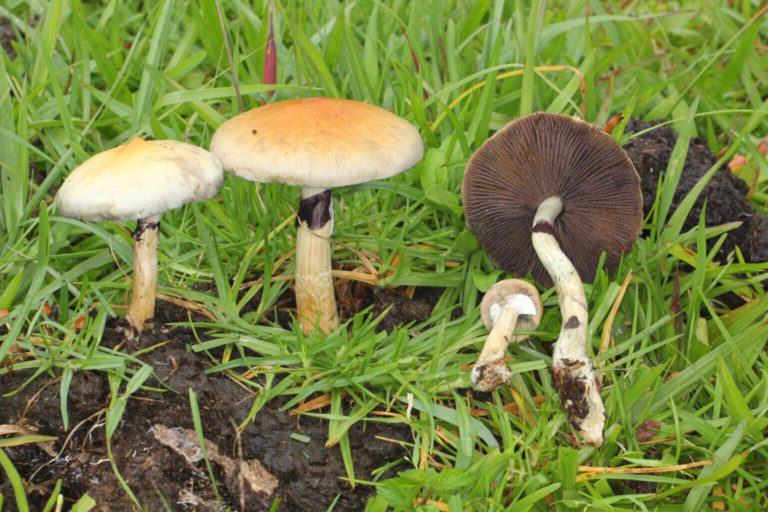
Psilocybin: effects, benefits, and risks of magic mushrooms
After decades of neglect, psilocybin is nowadays the subject of dozens of studies and clinical trials all over the world, showing especially promising results in the treatment of conditions like depression or anxiety. In addition to its well-known properties in recreational or spiritual contexts, the news regarding its possible medicinal properties further adds to the interest to this compound.
What the latest science says
Domnauer’s team has managed to get chemical extracts from the mushroom to reproduce a behavioural pattern in mice that matches what has been described in humans: first, a period of frantic hyperactivity, followed by prolonged stupor during which they barely move. This confirms that there is real, measurable neuroactive activity — not suggestion or folklore.
In 2025, a study presented at the European Congress of Radiology (ECR) using functional MRI on patients intoxicated with Lanmaoa asiatica revealed significant anomalies in the default mode network and the frontoparietal network — brain regions closely linked to attention, memory and cognitive processing. The mushroom is doing something specific and consistent in the brain; we simply don’t know which molecule is responsible.
Furthermore, a metabolomics study published in Food Science & Nutrition (2025) analysed the plasma profiles of 20 intoxicated patients compared to healthy controls, opening a new avenue for understanding the mechanisms of toxicity at a metabolic level. Research is accelerating.
What now? Current situation and outlook
The race to isolate this phantom compound is on. Laboratories in Utah and Yunnan are fractionating extracts from the mushroom, trying to separate and test each molecule until they find the culprit. If they succeed — and it seems to be a matter of when rather than if — we would be looking at the discovery of an entirely new class of psychoactive substance. Not a derivative of something known, not a distant cousin of psilocybin: something completely new.
And this opens up fascinating questions that go far beyond recreational mycology: why does the human brain generate such a specific and universal hallucination? What neurological mechanism produces the concrete perception of tiny people rather than, say, colours, patterns or abstract entities? Could this unknown compound teach us something fundamental about how the brain constructs its perception of reality?
Meanwhile, Lanmaoa asiatica continues to be sold peacefully at the markets of Kunming, among stalls of vegetables and spices, like selling tomatoes at La Boquería. A delicious mushroom with an umami flavour, enjoyed by millions of people… that harbours within it one of the greatest unsolved mysteries of modern neuroscience.
The goblins, it seems, had been trying to tell us something for millennia. All it took was for someone to eat them raw to hear them out.