

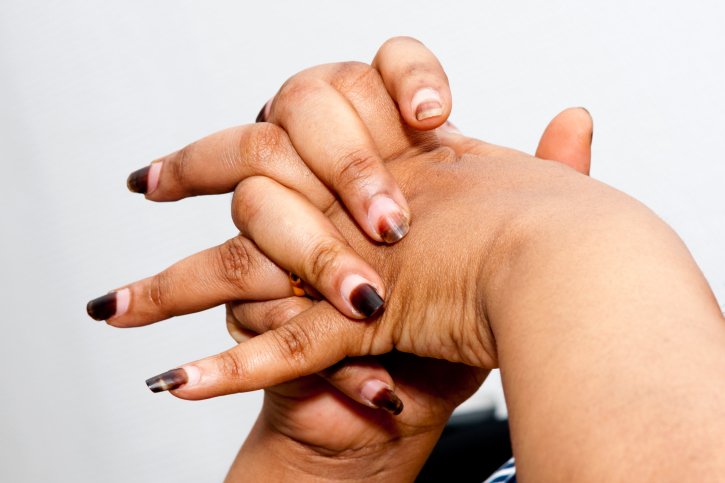
Take a good look at your fingernails. You may notice subtle changes in their color, shape, thickness or texture that you normally wouldn’t think twice about. But while not every nail imperfection is a cause for concern, certain changes can sometimes offer clues about what’s happening inside your body.
To a trained eye, your nails can provide valuable information about your overall health. That doesn’t mean you should try to diagnose yourself based on your nails alone, but paying attention to changes can help you know when it’s worth talking to a healthcare professional.
Here are six nail changes to watch for.
1. Thick or Separating Nails
If your nails suddenly become thicker, rougher or begin separating from the nail bed, there could be several possible causes.
Thickened nails may be associated with the following, according to the Cleveland Clinic:
- Injuries (trauma): Injuries to a nail or the area where your nails start to grow (nail matrix) can cause onycholysis. You can injure these areas by bumping or hitting your nails, wearing shoes that are too small or even keeping your nails in water for too long. Regularly going to a nail salon to get manicures can also cause onycholysis. Manicurists use a lot of force to trim, buff and polish your nails. Even tapping your nails on a hard surface over a long period can cause onycholysis.
- Reaction to chemicals: Chemicals in nail polish, nail gloss, nail hardener, nail polish remover and fake nails can cause onycholysis.
- Fungal infections: Fungal infections occur when fungus gets between your nail and nail bed, usually through cracks or cuts in your finger or toe. Fungal infections cause your nails to become thick and yellow, and they may show white spots and streaks.
- Medications: Chemotherapy and some medications that cause light sensitivity can cause onycholysis. These medications include tetracycline, nonsteroidal anti-inflammatory drugs (NSAIDs), psoralens and oral retinoids (vitamin A derivatives).
- Nail psoriasis: Nail psoriasis causes changes to the structure of your nails, which may include onycholysis.
Nail thickening is usually fairly easy to notice, especially when it develops gradually. If you notice a new or unexplained change, don’t simply cover it up with nail polish. A healthcare professional can help determine the cause.
RELATED: Your Nails Could Be The Answer To Your Unusual Symptoms
2. Ridges
Healthy nails are generally smooth, so prominent ridges that develop or become more noticeable may be worth noting.
Vertical ridges can become more common with age and aren’t necessarily a sign of illness. However, horizontal grooves or ridges that develop suddenly can sometimes signal an underlying health problem or an interruption in nail growth.
Depending on the type and appearance of the ridges, possible causes can include, according to the Cleveland Clinic:
- Normal aging: Many people develop vertical ridges on their nails as they get older. These lines aren’t dangerous.
- Skin conditions: If you have very dry skin or eczema, you may have vertical lines on your nails.
- Thyroid disease: If you have hypothyroidism, you may have thick, brittle nails with vertical ridges. Your nails may also crumble or break easily. They may look more rounded and your fingertip may be puffy.
Don’t automatically reach for a nail buffer to smooth away prominent ridges. If the change is new, deep or affecting several nails, it’s better to have it evaluated rather than simply covering it up.
3. Nail Discoloration
A healthy nail bed is typically pink, with a pale half-moon shape called the lunula near the base of the nail. Changes in nail color can have many causes, ranging from something as simple as staining from nail polish to an infection or an underlying health condition.
According to the Cleveland Clinic, the most common causes include:
- Bruised nail
- Mole (nevus) in your nail
- Repeated nail trauma, like nail biting, picking or friction from tight shoes
- Lentigos (“age spots” or “liver spots”) in your nail
- Genetics and race — people with medium to dark skin tones (more melanin) often develop it

The important thing is not to panic over a color change. Nail discoloration has many possible explanations, and a healthcare professional can determine whether further evaluation is needed.
RELATED: What Your Nails Say About Your Health
4. Pitted Nails
Do your nails have tiny dents or depressions that look as though someone poked them with a pin? These are known as nail pits.
Occasional nail pits can occur after an injury, but multiple pits across one or more nails may sometimes be associated with certain medical conditions, including:
- Psoriasis
- Psoriatic arthritis
- Genetic conditions like incontinentia pigmenti
- Reactive arthritis (also known as Reiter’s syndrome)
- Eczema
- Dermatitis
The pattern and severity of the pitting can provide important clues, so don’t assume that every tiny indentation means you have a health problem.
5. Brittle, Dry or Crumbling Nails
Are your nails constantly splitting, cracking or breaking? Dry or brittle nails can have several causes.
For example:
- Frequent handwashing. Constant washing and sanitizing can dry out nails and make them brittle.
- Aging. Our nails grow more slowly as we get older, so they take longer to grow out and have more exposure to dry air, water, and sanitizers.
- Length and cosmetic use. According to experts, you’re more likely to experience split, cracked, and broken nails if you grow your nails longer and regularly use nail cosmetics than if you keep your nails short.
- Chemotherapy. Cancer treatment can cause brittle nails. Speak to your oncologist for advice on preserving your nails.
The good news is that when an underlying condition causes brittle nails, treating the cause can allow healthier nails to grow in.
Remember, nails grow slowly. Fingernails grow about three millimeters per month, so it can take several months for a damaged or unhealthy nail to completely grow out.
6. Your Cuticles
Your cuticles aren’t just for cosmetics. They serve as a protective barrier between the nail and the surrounding skin.
“Cuticles are there for a reason, like a barrier or a protection for the nail matrix,” says Richard Scher, MD, a Cornell University dermatology professor.
For that reason, dermatologists generally don’t recommend cutting the cuticles.
Removing or aggressively pushing back the cuticle can create openings that allow bacteria and other organisms to enter, increasing the risk of irritation or infection. Infections around the nail can also interfere with healthy nail growth.
Bulging, swollen, painful or discolored skin around the nail may be a sign of infection and should be evaluated.
Cutting the cuticles can also contribute to nail problems, including ridges and white spots or lines. If you regularly get manicures, consider asking your nail technician to leave your cuticles intact rather than cutting them.
When Should You See a Doctor About Your Nails?
Most nail changes aren’t emergencies, and many have simple explanations. But a new or unexplained change that doesn’t go away is worth bringing to your healthcare professional’s attention.
Make an appointment if you notice:
- A new dark streak, especially on just one nail
- Nails that suddenly change color
- Significant thickening or separation from the nail bed
- Persistent pain, swelling or redness around the nail
- Multiple nails developing pits or deep ridges
- Changes that continue to worsen without an obvious explanation
Your nails can’t tell you exactly what’s wrong, but they can sometimes provide clues that something deserves a closer look. Instead of automatically covering up a change with polish or buffing it away, take a moment to notice what your nails may be telling you—and talk with a healthcare professional if something doesn’t look or feel right.