
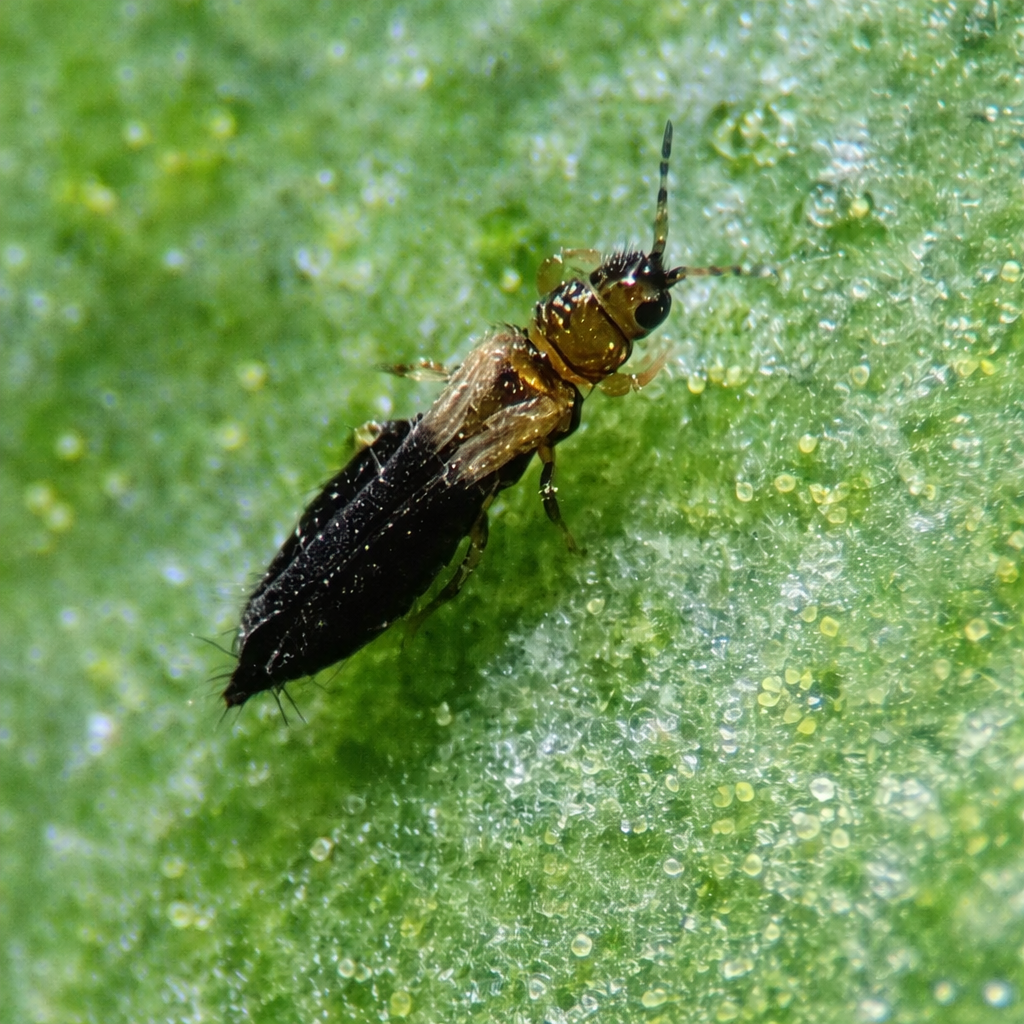
If you grow cannabis, you need to know about Thrips Parvispinus, also known as tobacco thrips. This emerging tropical pest has already been causing headaches in horticultural crops in Spain since 2024, and although there are not yet massive reports in cannabis, its extremely polyphagous nature (it feeds on many different plant species), together with rising global temperatures, means it is only a matter of time before it reaches your plants if you do not take preventive measures.
In this article we explain everything you need to know about Thrips Parvispinus: when and how it arrived in Spain, which crops it attacks, how to identify it, the damage it causes and, above all, how to protect your cannabis crop using an integrated pest management and biological control approach. Shall we begin?
What is Thrips Parvispinus and why should you be concerned?
Thrips Parvispinus is a thrips of tropical origin that feeds on leaves, flowers and fruits of a very wide range of plants. In recent years it has ceased to be a problem limited to ornamentals and has become a serious threat in greenhouse horticultural crops, especially pepper, where it causes scarring on the fruit.
Although pepper belongs to the Solanaceae family and cannabis to the Cannabaceae family (together with hops), this insect is polyphagous: it can easily move from one crop to another if conditions are suitable. This means that if you like growing peppers, tropical ornamentals or any other host plant near your marijuana crop, the risk of colonisation is real.
Which crops does it attack and why is cannabis at risk?
The “star” host in Spain is greenhouse pepper, but Thrips Parvispinus has also been reported on papaya, potato, numerous ornamentals and other horticultural crops. Its polyphagous nature means that it does not discriminate between plant families: if it finds a favourable environment and plant tissue to feed on, it will colonise the plant.
In the case of cannabis, the main risk points are:
Tender tissues: Young shoots and developing leaves are a feast for thrips larvae, which feed gregariously (in groups) and can distort growth.
Flowers and calyxes: Adults and larvae attack reproductive structures, causing flower abortion, necrosis and scarring on bracts. In a bud-producing crop, this results in loss of aesthetic quality, reduced weight and general plant stress.
Proximity to reservoirs: If you grow near pepper greenhouses, ornamental nurseries or areas with tropical vegetation, your cannabis plants can act as an alternative or secondary host, facilitating pest spread.

Damage and symptoms: how to recognise a Thrips Parvispinus attack
Damage caused by T. Parvispinus is mainly due to direct feeding. Unlike other thrips, current Spanish technical literature does not confirm significant virus transmission in horticultural crops (although some media have mentioned isolated cases). However, at Alchimia we are clear that, as with other thrips, it can act as a vector for certain latent viruses such as HLVd, Beet curly top virus (BCTV), Tobacco mosaic virus (TMV) and others, especially when working with cuttings. If the insect feeds on an infected plant and then on a healthy one, transmission can occur.
Visible symptoms on cannabis would be similar to those seen in other crops:
On leaves: A characteristic silvery or bronzed appearance appears on the upper surface, with yellowish areas and deformed edges. This is because larvae and adults scrape the leaf surface to feed on sap, leaving empty cells that reflect light differently.
On flowers: You may observe flower abortion (flowers that do not develop properly), necrosis (dead tissue with a brown-black colour) and deformities. In flowering crops like cannabis, this is particularly worrying because it directly affects final yield.
Excrement: As an additional clue, look for small black dots (insect excrement) on the underside of leaves and in silvery areas. This is a general indicator of thrips presence.
Field identification: how can you tell if it is Thrips Parvispinus?
Accurate identification of this species requires a good-quality hand lens or even a laboratory microscope, but there are practical features that can help you in the field:
Adults: Very small (around 1 mm), dark brown in colour. The wings have a pale base with the rest darker, and the legs and antennae are mostly yellow. If you observe these details with a 20–40× hand lens, you already have solid indications.
Larvae: Yellowish in colour and found in a gregarious manner (grouped together) on young shoots and the underside of leaves. This tendency to cluster is a distinctive feature compared to other thrips that may be more solitary.
Where to look: Focus your inspection on the underside of tender leaves, flowers, calyxes, petioles and sheltered areas of the plant. Remember that the pupa (the transition phase between larva and adult) is often found off the plant, in the soil or substrate, which complicates control.

Biological cycle and spread: why is it so difficult to control?
Thrips Parvispinus completes its life cycle very quickly in warm climates. Its optimal development occurs between 25–30 °C – the ideal temperature for cannabis crops – allowing it to produce several generations per season, especially in greenhouses where conditions are stable.
The complete cycle includes: egg → larva 1 → larva 2 → prepupa → pupa → adult. The pupal stage, which occurs in the soil or substrate, is key to understanding why traditional chemical control fails: if you only treat the aerial part of the plant, the pupae in the substrate will survive and give rise to new adults.
Presence peaks: In greenhouses, from spring to October, although it may continue through mild winters. Outdoors, activity is concentrated in the warm months.
Dispersion: Thrips actively move between nearby plants, are easily transported on nursery stock, plant material (cuttings) and contaminated tools, and can make short flights aided by air currents. This makes clean entry and quarantine critical measures.
Integrated management for cannabis: prevention is the key
Here is the crucial part: traditional chemical control is NOT effective against Thrips Parvispinus. Why? Because of its biology (fast cycle, refuge on the underside of leaves and in the substrate, pupation off the plant) and because broad-spectrum insecticides destroy the beneficial fauna that naturally controls the pest, creating a rebound effect.
Phytosanitary authorities, research centres (IFAPA, RAIF) and biological control companies (Koppert, Biobest) agree: the approach must be preventive, biological and based on hygiene and exclusion from the very beginning.
Below we detail the four pillars of integrated management adapted to cannabis:
1) Monitoring and thresholds: know your enemy
You cannot control what you do not know is there. Early monitoring is your best ally:
Sticky traps: Install blue sticky strips (yellow ones also work if you already use them for other pests). At a minimum, place 1–2 traps per 20 m² of crop, with higher density near entrances, doors and known hotspots. Check captures at least twice a week in greenhouses and indoor grows. Blue traps are especially attractive to thrips and will allow you to detect the first adults before the population explodes.

Horiver Wetstick by Koppert are adhesive strips in yellow and blue for capturing and monitoring pests such as whiteflies, thrips, fungus gnats and leaf miners. Ideal for ea […]
Visual sampling: Inspect the underside of young leaves and calyxes with a 20–40× hand lens. Look for grouped yellowish larvae, brown adults and black dots of excrement. Spend a few minutes each time you enter the grow; with practice, you will be able to detect problems before they are visible to the naked eye.
2) Cultural practices and hygiene: the foundation
Many T. Parvispinus infestations begin due to carelessness when introducing material or poor hygiene. Strengthen these points:
Clean entry to the grow: Establish a 10–14 day quarantine for any cutting or plant entering your grow space. During this time, inspect visually and with traps. Disinfect tools, clothing and footwear before entering. If you grow in a greenhouse or indoor space, consider installing insect-proof nets on vents and access points.
Constant sanitation: Immediately remove heavily affected shoots, severely damaged leaves and plant residues from pruning. Bag this material and remove it from the grow area; do not leave it in piles nearby, as it can act as a reservoir.
Substrate management: Avoid substrate cracking or accumulation of plant debris on the surface. Thrips pupate in the soil, so a clean, well-managed substrate hinders their cycle. Consider using soil-dwelling predators (see below) to attack pupae.
Physical structure: In greenhouses and indoor grows, install insect-proof filters on all vents and openings. This drastically reduces adult entry from outside. There are also insect-proof filters specifically designed for grow tents and extractors.
3) Biological control: the backbone of management
This is where you can really make a difference. Biological control is based on releasing natural predators into your crop that feed on thrips at different stages. The key is to act preventively (before damage appears) and to combine several natural enemies to cover all stages.

Foliar predators (for larvae and adults on the plant):
Orius laevigatus: This anthocorid bug is a voracious predator of adult and larval thrips. It works especially well in flowering crops because it also feeds on pollen. In cannabis, you may need bank or trap plants (for example, interplanted hot peppers) to maintain Orius populations even when thrips are scarce. Early releases are recommended, either as shock releases (single massive releases) or inoculative releases (small repeated releases).
Predatory mites: Amblyseius swirskii, A. montdorensis and Neoseiulus cucumeris are your best allies for preventive control. They feed on thrips larvae (as well as other mites and whitefly eggs). Release them preventively from transplant or early in the cycle, and reinforce in hotspots when you detect increases. These mites establish well under typical cannabis temperature and humidity conditions and are compatible with most bio-insecticides.
Other predators under evaluation: Franklinothrips vespiformis (a thrips predator of other thrips) and some products such as Entomite-M are under trial or used locally. Check with your biological control supplier for the latest options.
4) Bio-insecticides and compatible products: the last resort
If, despite all the above, a high-population hotspot appears, you can resort to contact bio-insecticides or entomopathogenic fungi, always within regulations and prioritising products compatible with beneficial fauna.
Potassium soaps and vegetable oils: Products such as Oleatbio by TRABE (potassium soap) act by contact, dehydrating juvenile and adult stages. They have low impact on beneficials if applied locally and with respect for reapplication intervals. Apply during low light hours (dawn or dusk) and focus on hotspots rather than the entire crop.
Rotation and localisation: Never apply the same product continuously or across the entire surface. Rotate active ingredients, apply only to detected hotspots and respect safety intervals before releasing beneficials or harvesting.
Quick checklist: protect your crop step by step
Here is a summary of the whole process in a list of concrete actions:
Before planting:
- 10–14 day quarantine for any cutting or plant entering your grow.
- Install insect-proof netting on vents and access points (greenhouse/indoor).
- Prepare hygiene points (disinfection of tools, footwear and clothing).
At the start of the cycle (prevention):
- Release preventive predatory mites (swirskii, montdorensis, cucumeris) at transplant or during the first weeks.
- Place blue sticky traps (5–10 per 100 m²) and record captures by area.
- If growing in a greenhouse with flowering plants or banker plants, introduce Orius laevigatus.
During cultivation (early detection):
- Visual inspection with a hand lens at least twice a week: underside of young leaves, flowers and calyxes.
- Map hotspots: note where activity is detected to focus reinforcements.
- If populations rise: reinforce predators in the affected area.
In the event of high-population hotspots (action):
- Sanitise heavily damaged shoots or buds: bag and remove from the grow.
- Localised applications of compatible bio-insecticides (potassium soap, oils, Beauveria).
- Reinforce soil predators (Dalotia) if pupae are an issue.
End of cycle / harvest:
- Thorough cleaning of the grow space: remove all plant residues.
- Sanitary break before the next cycle (minimum 1–2 weeks without plants).
- Disinfect structures, trays, pots and tools.