Department Of Education Labels Low-Paying Degrees A ‘Bad Investment’ And Moves To Cut Federal Funding For Said Programs – AfroTech

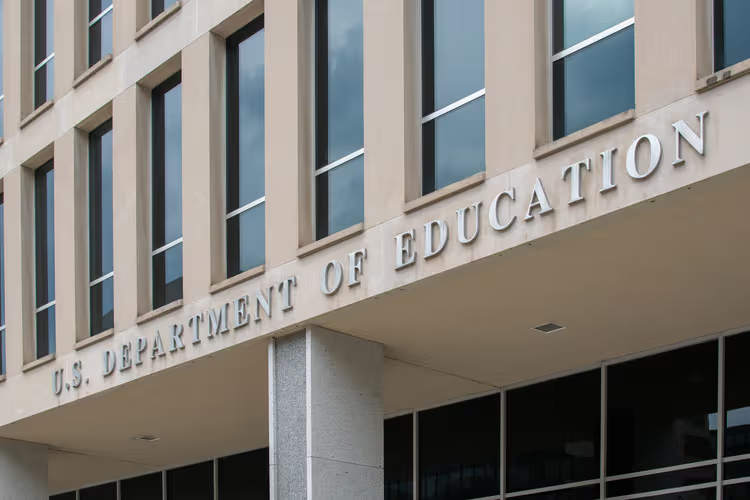

There may soon be a shift in higher education.
According to The Washington Times, the Department of Education will no longer fund college degree programs that cannot demonstrate their alumni earn more than high school graduates. This was decided by public- and private-sector policy stakeholders who voted on a decision that could impact higher education, including trade school certificates and graduate degrees.
The rule ending support for “consistently failing programs” will take effect in July 2026 and will also impact eligibility for federal loans as well as Pell Grants, which have been helpful for low-income students.
“After more than 15 years of regulatory uncertainty under the previous three administrations, we’ve developed an accountability framework that institutions can work with, students will benefit from, and taxpayers can rightfully expect to improve outcomes,” Under Secretary of Education Nicholas Kent said in a statement, according to the outlet.
The Department of Education stated that under former presidents Barack Obama and Joe Biden, funds provided had been contingent upon “tax status and politics rather than student outcomes,” which played a part in the $1.7 trillion spent on federal student loans.
“Poor earnings, coupled with high costs, make college a bad investment for too many students, ultimately leaving taxpayers to shoulder the burden when some borrowers default,” the department mentioned in a release, according to The Washington Times.
Some are praising the efforts of the justice department, including Peter Wood, president of the conservative National Association of Scholars and a former associate provost at Boston University.
“This doesn’t mean that colleges should cease to offer instruction in areas for which there is low demand for degree holders,” Wood expressed, according to the outlet. “It just means that the resources of the federal government should be spent supporting students who are preparing for the work that the nation needs.”
Wood also predicts colleges and universities will dismantle their fine arts, humanities, social sciences, and ethnic and sexual studies programs as a result.
Dick Startz, an economist at the University of California, Santa Barbara, predicts the rule could mean students have even less access to slightly better earning potential, though these are still “just plain low” wages and fall below projections of what high school graduates earn on average, which was $42,590 in 2023.
Additionally, professors reinforce their concern for fields like the humanities, history, and literature, which support a classical education.
“College isn’t just a workforce development program,” Jonathan Zimmerman, a professor of the history of education at the University of Pennsylvania, told The Washington Times. “It’s supposed to teach people about the world.”