
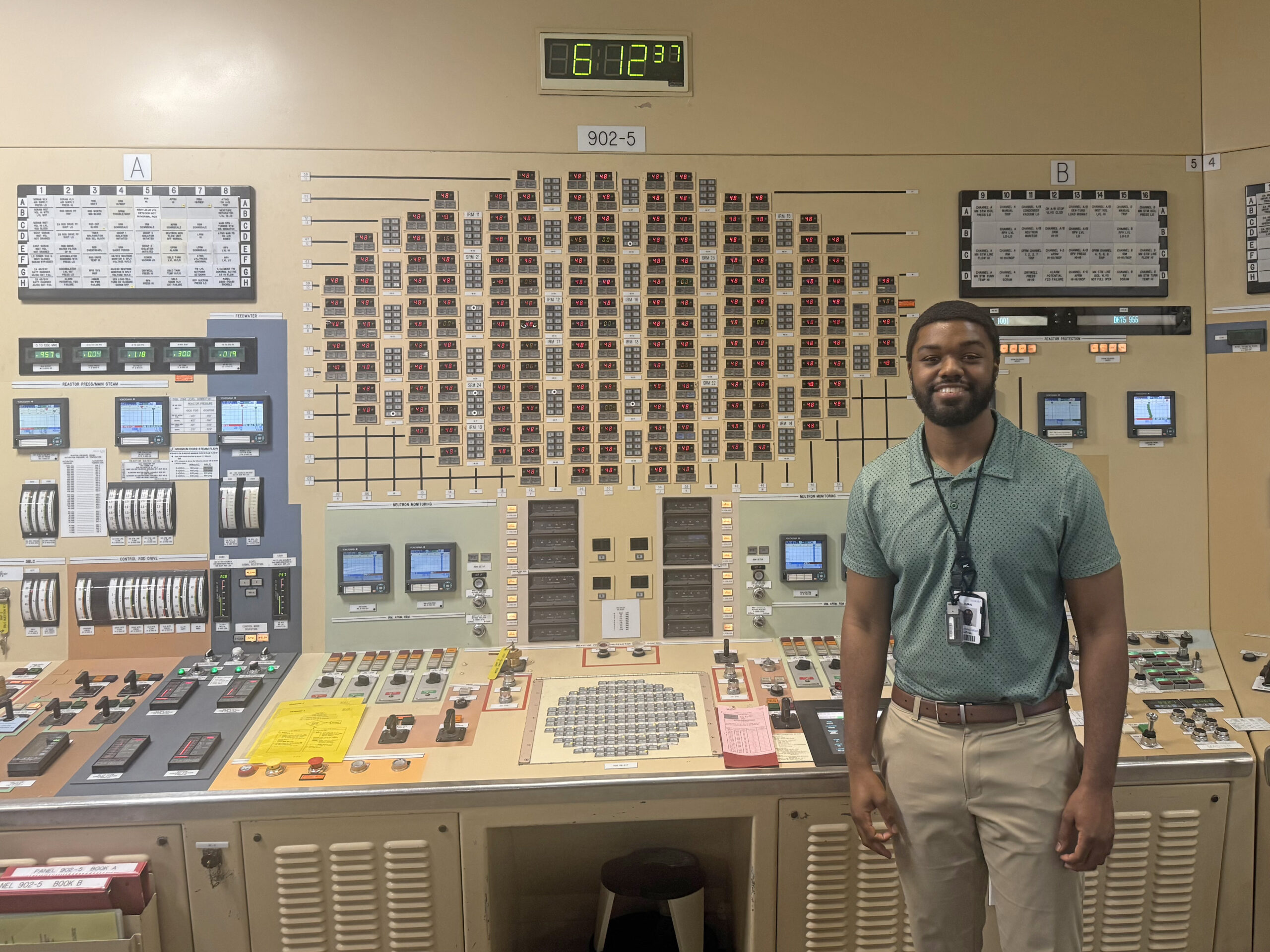

South Carolina State University students can now train to operate an advanced nuclear reactor without leaving campus.
The university has opened a NuScale Energy Exploration (E2) Center, a simulated nuclear control room designed to mirror operations inside an advanced nuclear power plant. According to a press release from SC State’s Office of University Relations, the center is one of only 10 of its kind worldwide and the only one in South Carolina.
The development expands access at an institution already holding a unique position in nuclear education. SC State is the only HBCU in the nation, and the only institution in South Carolina, offering a four-year nuclear engineering degree, according to the Office of University Relations press release.
For students like senior nuclear engineering major Jamal Wigfall, that education is already translating into experience inside the industry. According to a separate SC State press release, the 21-year-old Mobile, AL, native recently served as a corporate radiation protection intern with Constellation Energy at Dresden Generating Station in Morris, IL.
His experience offers a glimpse into the type of work SC State’s new simulator is designed to help more students prepare for.
Inside SC State’s Reactor Simulator
The centerpiece of the E2 Center is NuScale’s Small Modular Reactor simulator, which uses computer modeling to replicate advanced nuclear plant operations.
“Through interactive training, students learn to operate a reactor, monitor systems, and respond to emergency scenarios,” Dr. Musa Danjaji, chair of SC State’s Department of Engineering, said in the release. “Such skills are critical to careers in the nuclear energy sector.”
The simulator also arrives as the nuclear energy sector looks toward workforce development.
“As clean, reliable power demand grows, so does the need for skilled professionals,” NuScale President and CEO John Hopkins said, per the release. “This facility will offer students practical experience, problem-solving skills, and the expertise to advance clean energy solutions.”
Connecting The Classroom To Nuclear Operations
Wigfall has already experienced that transition from academic study to nuclear operations.
According to the SC State press release focused on his internship, Wigfall conducted baseline measurements of cesium-137 across six Midwest Constellation sites, collecting 48 samples and creating an updated baseline of cesium levels.
During an interview with AFROTECH™, Wigfall described recognizing concepts from his SC State coursework while job shadowing Constellation’s Reactor Engineering group.
“Being able to discuss those topics inside an operating nuclear facility showed me that the foundation I was building in school was directly applicable to the industry,” Wigfall mentioned.
His internship also exposed him to multiple areas of plant operations, including reactor engineering, radiation protection, and the ALARA team, where he learned how professionals plan work, estimate radiation doses, and protect workers from unnecessary exposure.
“Rather than seeing myself as someone pursuing one specific job title, I began to see myself as someone with a nuclear engineering degree and a nuclear background with a wide range of possibilities in front of them,” Wigfall said.
Expanding An HBCU Pipeline Into Nuclear Energy
SC State’s E2 Center adds another component to the university’s existing nuclear research and workforce development offerings.
According to the Office of University Relations release, SC State is a member of the Battelle Savannah River Alliance and works alongside other institutions in support of Savannah River Nuclear Laboratory. As previously reported by AFROTECH™, the state also awarded SC State $8 million to support STEM education, research, and workforce training efforts connected to that work.
For an HBCU that is already the only one in the country offering a four-year nuclear engineering degree, the simulator provides another point of access to an industry where Wigfall said he sometimes found himself among few people who looked like him.
“I wanted to help challenge stereotypes, demonstrating that talent, intelligence, and leadership can come from anywhere,” Wigfall told AFROTECH™. “I hoped that by doing my job well, I could help create opportunities for the students who come after me.”
For Wigfall, what happens after students gain that access matters too.
“If my story can inspire one student to believe they belong in engineering, science, or any challenging field, I’ll consider that a success,” he said. “I want young people, especially young Black students, to see what’s possible and know they can achieve it too.”