
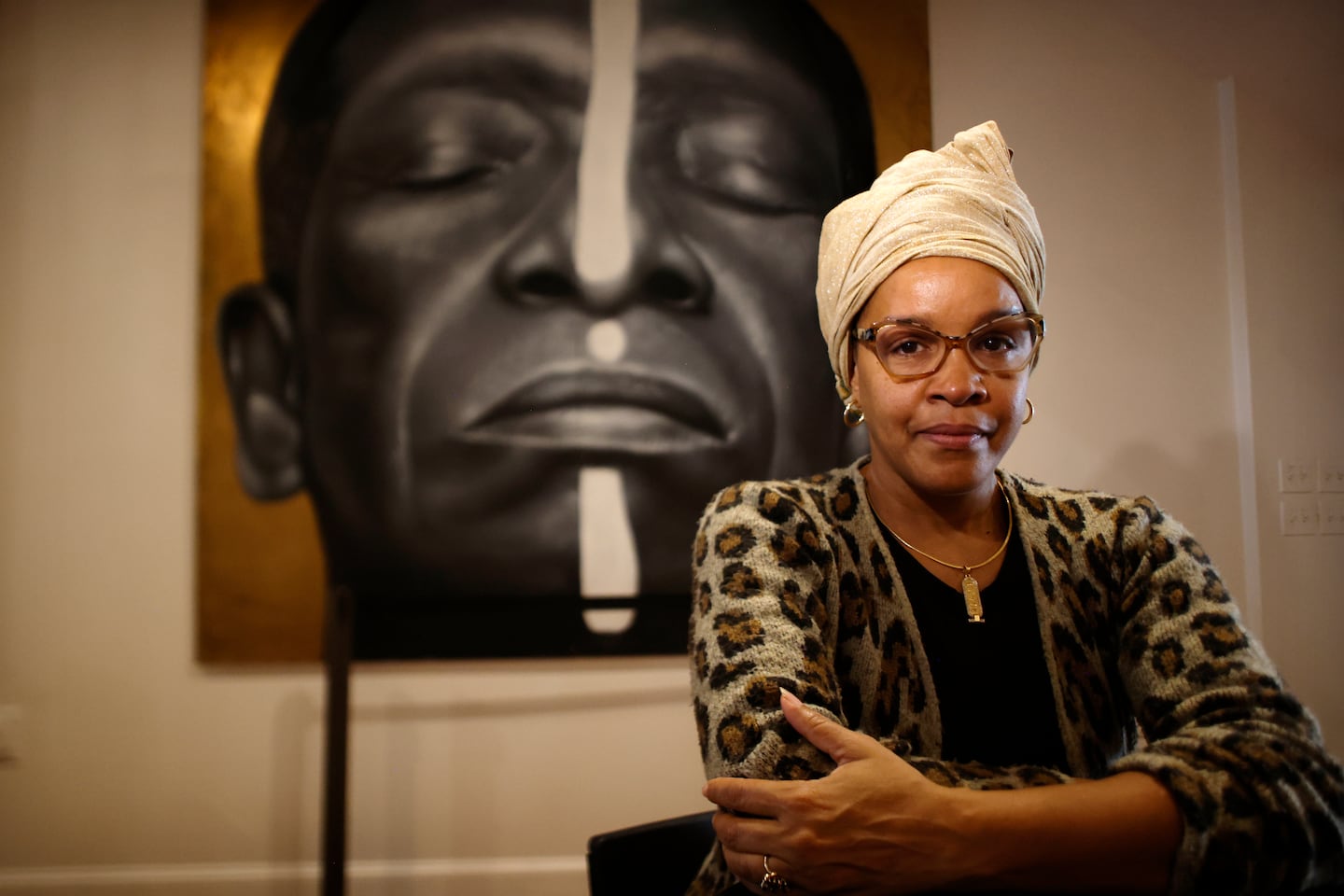
“In a time of rapid gentrification and displacement of Black spaces, our fight is not just for survival, but for the right to remain and thrive in the community we have always called home,” Kai Grant said in the video. “We must act quickly to not be uprooted from the ecosystem we have worked so hard to build.”
Their campaign’s aim was to raise funds. But it also raised some eyebrows — and questions.
Many were surprised to learn that the Grants didn’t already own the building outright; they simply had an option to buy it for $1.3 million. Others asked why an organization that had recently been awarded an $823,000 city contract for “creative placemaking” would struggle to keep its doors open. And some wondered why Madison Park, a Roxbury nonprofit of long standing, was at odds with a small business that seemed to share its mission.
While the two parties have now reached a tentative detente, the conflict highlights the tenuous status of Black-owned businesses and spaces in Boston, six years after the outpouring of support in the wake of George Floyd’s murder in 2020. And it renewed focus on the persistent challenges facing Nubian Square, a Black commercial hub in the heart of the city that has never quite reached its potential.
In an interview, Kai Grant said their lease agreement with Madison Park “was supposed to be about becoming a model for equity and antidisplacement” that ensured artisans, founders, and microbusinesses could stay in Roxbury. She feared Black Market would lose its space just as the neighborhood begins its long awaited metamorphosis.

“We’ve always had the mindset of creating this idea of Nubian Square as this premiere destination for the city of Boston,” she said. “Are we going to be able to see ourselves in the future that we created?”
But Monica Dean, a longtime community development executive who became Madison Park’s chief executive in February, said that Black Market “has not been able to uphold their end of the bargain,” and that Madison Park would put its own finances at risk if it continued to subsidize their lease. According to documents reviewed by the Globe, the Grants owed $124,229.12 in unpaid rent accrued over 32 months between 2021 and 2023 — a time when Madison Park also covered the cost of repairs, insurance, and real estate taxes.
“We’re a nonprofit, and we’re committed to working with small businesses, entrepreneurs, and those aspiring to become entrepreneurs,” said Dean. But in the case of Black Market, she continued, “we’ve not been able to confirm exactly what their business model is.”
‘It would be a big loss’
The Grants opened Black Market Nubian in 2017, envisioning a launchpad for Black-owned businesses in the center of the city’s Black core. For years, they hosted a marketplace out of the first floor of the 4,300-square-foot building on Washington Street, offering space to food, fashion, and craft vendors they hoped would plant roots and grow in Nubian Square.
Post-COVID realities and the changing nature of the neighborhood made the Grants rethink that business model, pivoting to position Black Market more as a cultural space — an arts and events venue, and even for a time offering co-working. They’ve partnered with the city on mural installations around Roxbury and for five years have hosted an annual block party, which last year featured artists like Slick Rick and Doug E. Fresh.

Black Market’s work to create space for artists in Roxbury has been formative for creatives like Cedric Douglas, whom the Grants commissioned to paint a massive mural of Donna Summer on the side of the Black Market building in 2024. Douglas said their annual block party not only promotes a message of Black-ownership in the neighborhood, but strengthens community ties and helps inspire the next generation of artists.
“It would be a big loss if they were to leave,” Douglas said.
But the Grants say a confluence of external factors has thwarted their ability to raise enough money to buy their building: rising retail vacancy in Nubian Square; ongoing construction; the migration of the opioid crisis from nearby Mass. and Cass.; and a retreat of civic and philanthropic commitments made during the racial reckoning of 2020 and 2021.
The Grants have also struggled to fulfill their own vision. They were awarded a prized city liquor license in the hopes of hosting more events, but don’t yet have the operating capital to afford the $110,000 it would cost to install a new fire alarm system and meet city codes. And while the city helped them with a $50,000 grant from its Cultural Space Fund toward the purchase of their building in 2023, Kai Grant said the local bank they had partnered with to help complete the deal backed out of the agreement.
“We weren’t able to get the traction we needed to get to the finish line,” she said.
Still, Black Market has received considerable outside support.
In 2024 the city awarded the market the $823,000 contract to implement placemaking efforts in the Roxbury arts corridor along Massachusetts Avenue, Columbus Avenue, and Grove Hall. According to city records, those funds have been paid out regularly for the past two years. The money is now being funneled to contractors to develop Ascension, a performing arts pavilion that’s been proposed for a vacant lot next to Black Market. It is scheduled to open in late summer or early fall.
“In order for us to be a thriving city we need an ecosystem of multicultural business,” said Imari Paris Jeffries, president and chief executive of Embrace Boston. “I’m rooting for all parties involved to get what they need in order to be sustainable.”

The dispute comes at an inflection point for Nubian Square, Jeffries notes. Franklin Cummings Tech last year opened a new campus in the neighborhood, bringing long-sought foot traffic in the form of hundreds of students. After years of delays, the Jazz Urbane nightclub last month secured $2.6 million in financing and is scheduled to open in May.
At the same time, some in the neighborhood are rankled by Mayor Michelle Wu’s recent move to scrap plans to build lab space and affordable housing on a long-empty parcel along Tremont Street, and look at putting a new Madison Park vocational high school there instead. The canceled project was to include a museum and cultural center for Embrace, Jeffries notes, and the lab space would have brought good jobs.
Now, he said, the potential loss of Black Market has drawn additional concerns.
“[The Tremont Street project] was de-designated,” he said, “and to see this other viable commercial space in trouble is disheartening.”
That sentiment is shared by others who want to ensure that longtime local institutions don’t fall through the cracks of Roxbury’s hoped-for resurgence.
The Black Economic Council of Massachusetts recently purchased its own building on Roxbury Street in Nubian Square for $1.5 million. With the neighborhood on the upswing, said executive director Nicole Obi, ownership is key to building wealth and providing stability, for residents and business alike. But no one group can solve the challenges that have plagued Nubian for generations.
“It’s bigger than one organization, it’s really about the whole area,” Obi said. “There is no lack of interest and ideas and plans, but there needs to be coordination.”

Some argue that while the mission of Black Market is well-intended, its execution has fallen short. In the last few weeks their fund-raising effort raised hackles among some locals like Joao Zezito DePina, who took to Facebook asking why in a moment of broad economic hardship, people should be asked to contribute to a “fiscally irresponsible” organization.
“If you have all those resources and you haven’t paid your rent in three years,” said DePina, a florist and community activist who ran for City Council in 2021, “why should we come in and bail you out?”
After hosting a series of events at Black Market over the past two weeks, the Grants were able to raise over $33,000 toward the purchase of their building — one-tenth of what they needed. But for now, it seems they’ll be able to stay put for a little bit longer.
They have come to terms with Madison Park to remain open.
On Thursday, Kai Grant said that they now need to reach a goal of $80,000 instead of the $369,000 they’d set out to raise in their original campaign.
“I just want to respect the process and stay grateful for all the support for the past two weeks, it was incredible and overwhelming,” Grant said. “It’s important to know there’s an opportunity for us to make it to 10 [years].”
Dean said she was disappointed by the narrative that Madison Park was somehow pushing out Black Market. This week, she sent a statement to the Globe saying Madison Park was providing Black Market “with an additional opportunity to fulfill the terms of the original agreement.”
“We’re bound by confidentiality not to discuss the means of such opportunity,“ Dean said, ”but we wish Black Market the best.”

Janelle Nanos can be reached at janelle.nanos@globe.com. Follow her @janellenanos.