West Ninth Street Black business district aims to echo the past, but with a modern twist

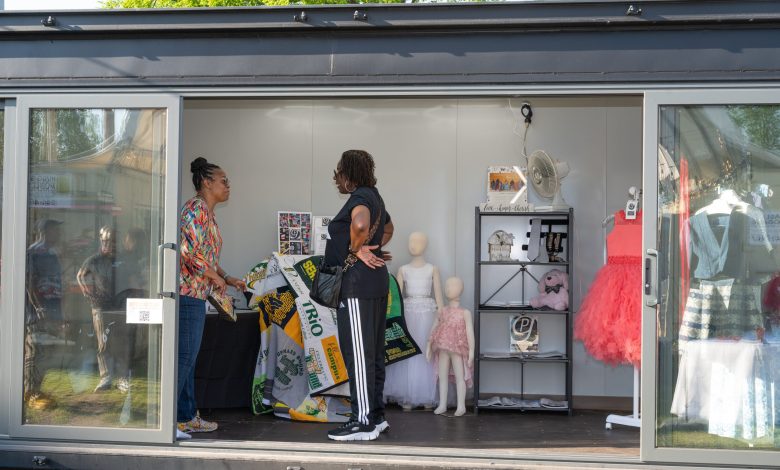
Over 20 Black-owned businesses welcomed a constant flow of customers and curious shoppers Wednesday evening as they mingled in transformed shipping containers amid a backdrop of music handspun by a DJ and beautiful weather.
The event marked the launch of the project, Beyond the Divide: Reconnecting W. Ninth Street to the Hearts of Little Rock.
The new Black business district blocked off part of the street, which will remain that way until Juneteenth, with the project aiming to realize the historical significance and hopeful revitalization of the area.
Little Rock leaders, such as Mayor Frank Scott Jr., City Directors Antwan Phillips, Virgil Miller and Andrea Lewis, were present at the launch, which happened near The Hall, a concert venue.
A crowd of people of all ages flowed in and out of the shipping container district, trying food samples, looking at colorful and handmade clothing, sitting down and chatting with friends and, of course, buying items for sale. The goal is to recreate some parts of the thriving Black corridor that was destroyed, starting in the early 1960s, when the city constructed Interstate 630. Black entrepreneurship and culture lived along West Ninth Street.
In a speech to kick off the launch, architect from studioMAIN and project lead Ernest Banks thanked Phillips and Chloe Chapman, who he said helped make the project possible.
The business district has been a culmination of several months of planning and work by Banks, Chapman and other associates.
“Opportunities like this don’t come very often,” Banks said.
Scott made remarks about how his mother grew up in the South End of Little Rock and would tell stories about visiting West Ninth Street as a child. Scott’s mother would get her hair done and visit different shops.
“Under the guise of urban renewal, this area was redlined,” Scott said, referring to a discriminatory system of denying mortgages, insurance and banking services to minority populations. “And then the federal government cemented those red lines through I-630, and it cut off economic activity that was created by the Black residents of this great city. And so that’s the reason why you see that not so much has happened. We are very grateful that in that time we’ve been able to bring some things back.”
Scott said he hopes that the project can fuel economic aspirations and activity and bring in more capital to the area.
When he spoke, Phillips thanked Banks for his commitment and persistence in the project.
“Another thing I want to mention is that this is a fruition of where community and collaboration comes together,” Phillips said. “There’s a lot of different people involved, and all under the idea that Ninth Street needs to be more than what it was, and we can make it whatever we want it to be.”
Key Fletcher, director of the Mosaic Templars Cultural Center, said that it was great to be in a space that honored Black history and the formerly enslaved people who helped make West Ninth Street what it was. The district connects a historical throughline to the past.
“We hope that this project will help people to pause, to take a look at the space differently and to understand that West Ninth Street is more than what is visible today,” Fletcher said. “We hope that what is happening today can be carried forward to future generations, because this community has never disappeared. It has endured. It has adapted, and it has held on to its identity, even with so much around it changing.”
Mosaic Templars is partnered with Beyond the Divide, which will have the shipping containers up through Juneteenth, around the time when Mosaic Templars will have its annual “Juneteenth in da Rock” celebration. The vendors will be there the entire time.
Hugg & Hall Mobile Storage provided the shipping containers needed for the transformation. Smart Growth America, a national nonprofit whose mission is to rebuild areas impacted by divisive infrastructure, awarded Little Rock a $45,000 Community Connectors grant in late September 2025 to reinvigorate West Ninth Street.
Supporters of Beyond the Divide have previously gathered to paint along West Ninth Street to help beautify the area. More art is planned to come.
One vendor, Krystal Cornelius, sells handmade jewelry and brooches with colorful themes, such as mermaid brooches, the Venus of Willendorf figurine earrings and shiny new West Ninth Street sign earrings made for Beyond the Divide.
Cornelius said that she felt heartbroken learning about the fate of the historic West Ninth Street.
“That was a cool place, and that was something that was taken from the Black community here,” Cornelius said.
She said she wonders what the street would have looked like had it not been partially razed, but she is honored to be part of this revival.
“I hope and I feel like we’re doing our homage to the Black entrepreneurs who were here before us,” Cornelius said. “You can’t stop Black people, you can’t stop us. So here we are back, and I’m hoping that we’re doing it proud.”
Marion Humphrey Jr., a lawyer, has a shipping container dedicated to providing people with professional legal services. Humphrey said that he aims to be a resource to future entrepreneurs and can also help with notary services, as well as answer general questions. Beyond retail sales, West Ninth Street also acted as a place for Black people to receive services, he said.
“What I know as someone born and raised in Little Rock is that Ninth Street was a place that mixed commercial with professional, business with fun and enjoyment and entertainment, and I want to see that. I have that vision, I want to see it again. I want to see these spaces be reclaimed as a multi-use place. So I wanted to also offer up for this short term, an opportunity for me to get out of my office, but to be in a space that’s more open and inviting to people of all walks of life,” Humphrey said.
Sylvia Tyler is the owner of Chocolate Spoon, a boutique-style dessert shop.
Tyler describes the desserts she makes as the kind that your grandmother would have made, such as pound cakes, red velvet cakes and banana pudding.
She described being in a full circle moment, as her great grandfather had a medical practice in what used to be Taborian Hall, now the Flag and Banner building, but was previously a place where Black businesses were located as well as the Dreamland Ballroom. The ballroom brought in many iconic Black musicians such as Ella Fitzgerald and Duke Ellington, as Little Rock was part of the Chitlin’ Circuit.
“It was just kind of surreal to be so close to where he was,” Tyler said. “Here I am in this historic moment.”