
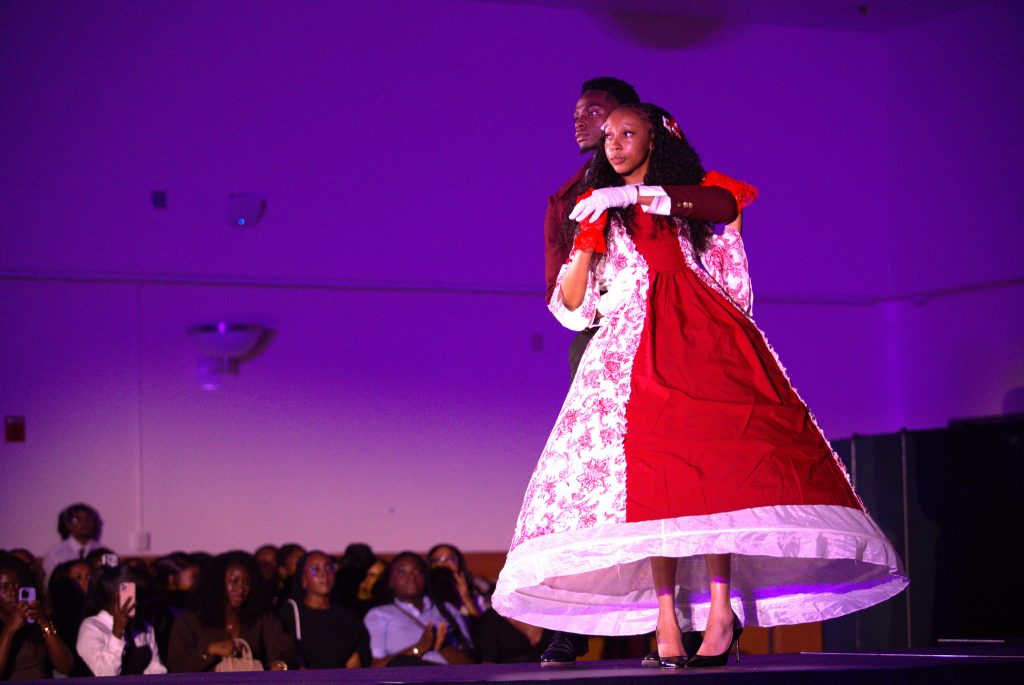
The fashion show featured style from four different, and vibrant eras.
On Friday Oct. 2, the Black Student Union reimagined Black excellence across different historical eras through fashion, dance and music at its 58th-annual Homecoming Fashion Show.
This year’s theme, “Luxe Noir: Rewriting the Timeline,” moved through four distinct eras inspired by African royalty, the Regency period, the Harlem Renaissance and modern Black dandyism.
Kalea Andrews, BSU’s social cultural coordinator and a junior studying philosophy, politics and law, discussed how the theme challenged traditional narratives surrounding Black identity and success.
“When creating this show, I wanted to tell a story,” Andrews wrote to Pipe Dream. “I wanted to show that Black people are more than the struggles, stereotypes, and limitations that have been placed on us throughout history. So often, being Black can feel like we are expected to start at the bottom of the barrel, constantly having to prove that we belong in spaces of beauty, elegance, wealth, creativity, and luxury. But luxury is not something that has to be given to us or something we have to earn the right to experience. Blackness itself can be luxurious.”
Held in the Mandela Room, the evening began with what organizers described as the “Black Crown Era.” Before models took the runway, emcees explained that African civilizations were centers of wealth, culture and influence long before modern luxury brands and fashion houses arrived.
The collection featured gold accents and looks that blended traditional African-inspired styles with contemporary fashion.
The second segment reimagined the Regency era through a Black lens. The looks incorporated colorful and floral designs, pearls, corsets and tailcoats while adding modern interpretations of period fashion.
One model wore a traditional Regency-era dress, while another was styled in a yellow lace mini dress, with lace socks and ankle-strap heels.
Hillary Abankwa ‘26 designed both the Black Crown and regency-era segments of the show, and has worked on multiple BSU fashion shows in prior years.
Abankwa highlighted how the design process involved extensive research and inspiration from sources such as Pinterest and period dramas.
“It’s [about] making people feel confident,” Abankwa said. “If my models didn’t feel confident in what they’re wearing, I just didn’t feel like I achieved the day.”
The third era drew inspiration from the Harlem Renaissance, celebrating Black creativity, fashion and artistic influence. Models showcased outfits reminiscent of the 1920s, with flapper-style dresses, vests, hats and other jazz-inspired looks.
This era envisioned Harlem not as a newly discovered cultural movement, but as a center of influence and innovation.
The show’s final era focused on Black dandyism. Featuring bold colors, fur accents and contemporary formalwear, the collection drew inspiration from modern interpretations of dandy fashion while incorporating a Met Gala-inspired aesthetic.
Emcees described dandyism as a movement centered on refined personal style, elegance and self-expression.
Between runway segments, the audience was entertained by performances from Black Dance Repertoire, MajorNoir and the Mu Kappa Chapter of Kappa Alpha Psi Fraternity, Inc. Audience participation remained a central feature throughout the evening, with attendees invited onto the runway to showcase outfits that aligned with the event’s theme.
Throughout the night, the show’s exploration of Black luxury and influence reinforced its central theme: the ability to reclaim and redefine one’s own story.
“If you do not like the way your own timeline or legacy is being perceived, written, or told, rewrite it,” Andrews wrote. “We are all living for the first time, and we have the ability to take control of our stories. Put your best foot forward, become the best version of yourself, and never allow someone else to decide what your story/timeline is supposed to look like.”