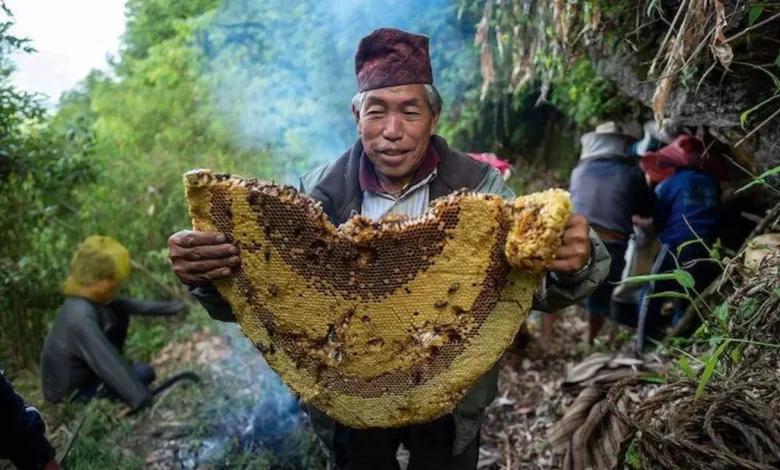
Did you know that hidden in the most inaccessible cliffs of the Himalayas there is a honey capable of altering the senses? Today we want to take you on a journey to Nepal to discover one of the most fascinating and mysterious natural products on the planet: psychoactive honey. A substance that combines ancestral tradition, extreme biology and a pinch of legend. At Alchimia we are passionate about natural substances with history, and this honey has so much that it would be enough material for several films. So make yourself comfortable, because we’re going to tell you everything you need to know about this very special liquid gold.
What exactly is psychoactive honey?
Psychoactive honey is a very particular variety that contains grayanotoxins, natural compounds capable of causing striking physiological effects on the human body. These substances are not made by the bees themselves, but reach the honey through the nectar of certain plants, mainly high-altitude rhododendrons.
Unlike the conventional honey you find in any supermarket, its consumption has historically been linked to traditional medicinal uses and very specific sensory experiences. But beware: its effects are neither uniform nor predictable, since they depend on the concentration of toxins, the amount ingested and each person’s sensitivity. This, as you’ll see later on, makes it a product that is as fascinating as it is delicate.
To understand why this honey is so special, you have to look at the place where it is born. The mountainous regions of Nepal are a real treasure of biodiversity, with ecosystems that change radically depending on altitude. The areas where this honey is harvested are located, no less, between 2,500 and 4,000 metres above sea level.
Up there the conditions are extremely harsh: tough winters, very specific flowering seasons and an isolation that has allowed unique species to evolve in the world. This combination of extreme altitude, plant diversity and geographical isolation creates the perfect setting for protagonists as singular as giant bees and grayanotoxin-producing rhododendrons to appear. An unrepeatable natural recipe.
The giant Himalayan bees, the real stars
One of the lesser-known (and most impressive) protagonists of this story is the giant Himalayan bee (Apis laboriosa), a species that can reach considerably larger sizes than the common bees you see fluttering around your garden. Imagine a bee almost the size of your thumb… and now imagine thousands of them together. Impressive, isn’t it?

These bees build their combs on vertical rock walls, often in places virtually inaccessible to predators. Their hives can measure more than a metre wide and house thousands of individuals, which translates into a considerable honey production when the harvest is good. That said, they are particularly defensive, which makes their harvesting a high-risk activity. Their behaviour and their adaptation to the mountain environment are the key to the existence of this very particular honey.
Rhododendrons and grayanotoxins: the botanical origin
The essential component of psychoactive honey comes from rhododendrons, plants that grow abundantly in certain areas of the Himalayas and that in spring tinge the slopes pink, red and white. Some species produce a nectar containing grayanotoxins, substances that act as a natural defence of the plant to prevent certain animals from eating it.
The curious thing is that bees are not affected by these compounds and gather the nectar with complete normality. The result is a honey that incorporates these toxins in variable amounts, which translates for the consumer into a product with potential effects very different from those of any other honey. That said, it’s worth clarifying that not all rhododendrons produce these compounds, which explains why not all the honey from the region has the same characteristics.
A story that comes from very far away
The existence of honeys with unusual properties is not exclusive to Nepal or to recent times. Already in antiquity, Greek authors such as Xenophon described episodes related to “toxic” honey. One of the best-known accounts tells how Greek soldiers, after consuming honey in certain regions of the Black Sea, experienced disorientation, dizziness and weakness for several days.
These episodes have been interpreted as possible cases of grayanotoxin poisoning, the same ones found in Himalayan honey. Although these accounts are far from Nepal, they show that the phenomenon of “special” honey has been observed in different parts of the world throughout history. Almost 2,500 years talking about the same type of honey and it’s still giving people something to talk about!
In Nepal, psychoactive honey has a value that goes far beyond its physical properties. For some communities, especially the Gurung, it is part of their cultural and spiritual identity. Its traditional use has been linked to folk medicine, where it was used in small amounts to treat ailments such as cough, hypertension or digestive problems.
It has also been associated with rituals and celebrations, although its exact role varies between communities. More than a product for everyday consumption, we are talking about a very special resource, reserved for specific moments and always handled with knowledge and respect. A philosophy that, by the way, fits very well with the idea of responsible consumption that we defend at Alchimia.
The psychoactive honey hunters
The honey hunters are undoubtedly one of the most impressive aspects of this tradition. Their work requires a combination of strength, skill and experience that is only acquired over the years… and with many stings along the way.

They know the behaviour of the bees perfectly, the access routes to the combs and the exact moments for harvesting. This knowledge is not written in any book: it is transmitted orally from generation to generation, which for you as a reader means that we are facing a living, fragile and unique knowledge in the world. In addition, the activity is usually accompanied by offerings, chants and rituals that reinforce the bond between the community and its natural environment.
How Himalayan honey is harvested
The harvest is a complex process that begins long before reaching the comb. The hunters must locate the hives, plan the access and prepare all the equipment. Once at the site, they descend the cliffs using handmade rope ladders that can be tens of metres long. Yes, you read that right: hand-made ropes hanging over precipices.
Smoke is used to calm the bees, although the risk of mass stings remains very high. The harvester cuts the combs with a long pole and places them in baskets that are then hoisted up by the rest of the team. The whole process requires millimetre coordination, because any mistake can have serious consequences. It is no exaggeration to say that each harvest is a small feat.
The figure of the honey hunter is often romanticised, but the reality is much harsher. Falls from great heights, mass stings and adverse weather conditions are constant risks. Added to this is the fact that the honey itself, if not handled properly, can cause unpredictable effects in those who consume it.
That is why traditional knowledge is not limited to harvesting: it also includes very precise guidelines on use, conservation and dosage. A reminder that, in nature, the most fascinating things are often accompanied by the greatest respect.
Composition and effects on the body
Let’s get to the heart of the matter. Grayanotoxins act on the nervous system by interfering with the sodium channels of cells, which alters the transmission of nerve impulses. This can cause a series of physiological effects that vary enormously in intensity depending on the dose.
Among the described effects we find a decrease in blood pressure, alterations in heart rhythm, dizziness, sweating, nausea and a sensation of weakness. In some cases perceptual alterations have also been reported, which is why it is known as “crazy honey” or mad honey. It is very important to stress that these effects can be adverse and dangerous, especially if consumed in high amounts or without knowledge. We are not talking about an innocuous recreational product, but a potent substance that in many countries is regulated or directly discouraged by health authorities.
Beyond its chemical composition, psychoactive honey has its own sensory traits. It usually has a more bitter and less sweet flavour than conventional honey, with an astringent touch that makes it unmistakable for trained palates. It also tends to be darker, with reddish tones, and somewhat denser in texture.

However, these characteristics are not always enough to identify it with certainty at first glance, which adds an extra element of uncertainty. For the consumer, this translates into a clear recommendation: never play at guessing and trust only sources with real knowledge of the product.
Curiosities you may not have known
One of the most striking things is that the production of psychoactive honey can vary enormously from year to year, depending on the climate and the flowering of the rhododendrons. Some communities even distinguish between different types of honey according to the season, attributing different properties to each harvest. Spring honey is usually considered the most potent, while that from other times has milder effects.
It is also fascinating that, in small amounts, honey with grayanotoxins has been the subject of study for its possible applications in medical research, especially in the cardiovascular field, although this field is still very much in development. And as if that were not enough, the harvest itself has been documented in numerous reports and documentaries that have become a true window into the traditional knowledge of these Himalayan communities.