
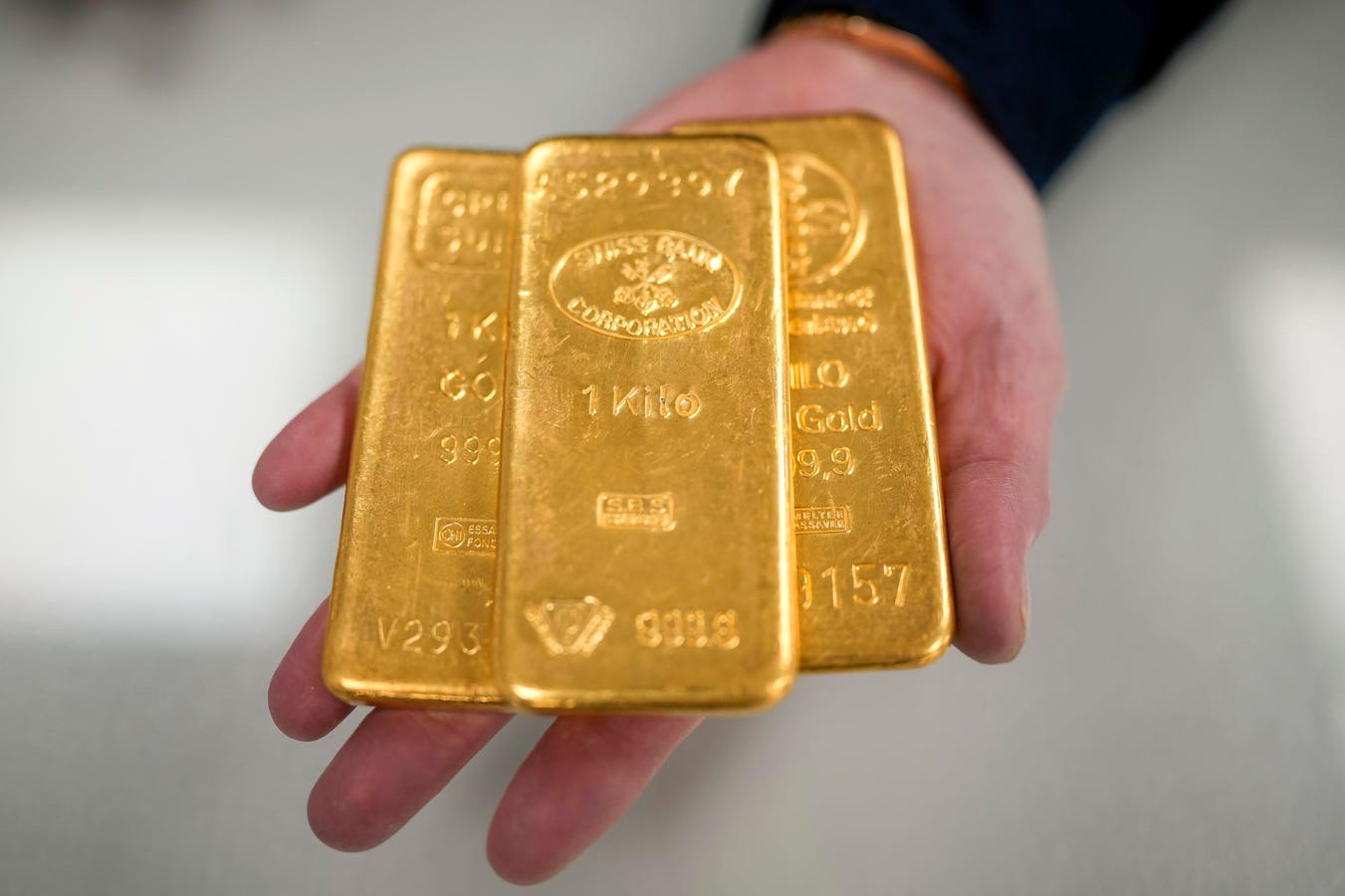

BIRMINGHAM, ENGLAND – DECEMBER 13: A jewellery quarter gold dealer poses with three 1kg gold bullion bars on December 13, 2023 in Birmingham, England. Gold prices have increased since the Ukraine War but have soared to record highs since the start of the Hamas-Israel war. Other factors are the weakening US dollar and expected rate cuts from the Federal Reserve. (Photo by Christopher Furlong/Getty Images)
Getty Images
“In crypto, through digital assets notoriously, that volatility has always killed people,”
said Andrey Didovskiy, chief executive of Seasons, a Solana protocol that has been depositing gold and bitcoin into strangers’ wallets twice a week since December.
“As that entropy rises more and more and we get more and more chaotic with AI and fragmentation keeps happening, humanity keeps searching for stability,” he said in an interview. “That’s a tale as old as time.”
The mechanism is a threshold. “It turns any kind of wallet address over 10,000 tokens into a node on the network, and that node effectively operates as a infinite DCA,” Didovskiy said, using the shorthand for dollar-cost averaging. Ten thousand SEAS runs to roughly $2,500 at recent prices. Every Wednesday and Sunday the wallet receives a payment in Tether Gold, wrapped bitcoin and a yield-bearing dollar token.
“You can also think of it as a miner,” he said, “because what happens is twice a week are the people receive Bitcoin gold and yield-bearing USDC.”
There is no staking contract and nothing to claim. “We don’t force users to do any kind of freezing,” Didovskiy said, or locking, or staking. Holders leave the tokens sitting in their own wallets and “become savings accounts.”
Where the money comes from
Seasons runs on three engines, and the one that matters is a levy the protocol calls the Transactional Transfer Tax. Didovskiy is unusually direct about it. “All trading activity absorbs a 10% fee that is then directly redistributed,” he said, among the nodes.
So a tenth of every purchase goes to the people who already hold the token, and a tenth of every sale does too. The gold that lands in a node’s wallet on Sunday was somebody else’s trade a few days earlier.
He does not present this as an invention. He traces it to the token designs of the last cycle, the ones built so that trading volume in a token would grow the token’s own market value. “Usually they were built with inflationary models,” he said. “So we took that as a foundation.”
The other two engines are smaller. A module called SSYM parks distributions in yield-bearing stablecoins while they are queued for payout. A set of vaults deploys reserves into lending and liquidity strategies, with the next one planned on Kamino, Solana’s largest lending market. “Since you have this kind of store of value, if you will, anyway, why not put it to some kind of work?” Didovskiy said. He allows that this introduces “new risks, new stuff.”
The numbers behind the yield
Seasons publishes its own figures weekly and they are modest. For the week ending July 24 the protocol reported $242,624 distributed since launch, $7,343 of it that week, across 339 node owners. It claimed an average annual percentage yield of about 12.56%, and put cumulative payouts at 8.28 ounces of gold and just over half a wrapped bitcoin.
Now the token. SEAS traded around $0.25 on Thursday with a fully diluted valuation near $250 million, on 24-hour trading volume of roughly $6,500, according to CoinGecko. It launched on December 9, 2025. Its circulating supply is not reported, so CoinGecko lists no market capitalization at all.
At $6,500 of daily volume, a 10% tax throws off something like $650 a day. That is roughly the size of the distributions going out.
The entry cost runs the other way. A 10% toll going in and another coming out is close to a fifth of the position, so at the advertised yield a node needs about a year and a half of twice-weekly payments to break even on tax alone, before the token price does anything. Spread across 339 nodes, the $242,624 paid since December works out at roughly $715 each.
Solscan counts about 7,000 SEAS holders. Only 339 clear the 10,000-token threshold. The rest hold the token, pay the tax when they trade and receive nothing.
Crypto has run this experiment before
Tokens that tax their own trades and hand the proceeds to holders were a defining product of 2021. SafeMoon, the most famous, launched in March 2021 with a 10% transaction tax split evenly between holder redistributions and the liquidity pool. In May 2025 a jury convicted its chief executive, Braden John Karony, of conspiracy to commit securities fraud, wire fraud and money laundering. He was sentenced to 100 months in federal prison and ordered to forfeit about $7.5 million in crypto assets, along with two residential properties.
That case turned on the misappropriation of liquidity advertised as locked, not on the tax mechanism. Prosecutors said the executives kept access to the pools and drained them. Nothing of the kind has been alleged here.
Seasons has closed off some of the obvious failure modes. The token runs on Solana’s Token-2022 standard, which supports transfer fees natively rather than through the bespoke contract logic that made the 2021 generation so fragile. RugCheck records show mint authority was revoked about seven months ago and freeze authority about eight, so no new supply can be conjured and no wallet frozen. Roughly 22% of liquidity is locked. And the payouts arrive in gold, bitcoin and dollars rather than in more of the protocol’s own token, which is what turned most reflection tokens into circular machines.
RugCheck still scores the token DANGER, on two counts: a low holder count, and the fee configuration itself. On Solana the authority that sets a transfer fee can generally change it later, subject to a delay of about four days.
What sustainable yield usually requires
“Crazy interest rate cannot sustain for like forever,” Jonathan Han, chief executive of Euler Labs, said on the On The Margin podcast. “I think everybody has learned that from the last couple of years.”
Han was talking about the hangover from DeFi Summer, when protocols advertised triple-digit returns funded by their own token emissions. He also described who is showing up now. “A lot of retail, average day people are coming on chain to find alternative yield sources and opportunities,” he said. Much of DeFi’s yield layer has been rebuilt since, with far less enthusiasm for headline numbers.
Seasons is not paying in its own token, which is the point Didovskiy keeps returning to. The money is still internal, though. Streamex also pays yield on tokenized gold, and its chief executive Henry McPhie has spelled out where his comes from. “Instead of just taking that gold and sitting at a bank vault, we make that gold active,” McPhie said on the On The Margin podcast.
“What we do is we lease the gold to people who use it as working capital,” he said, naming jewelers and refiners as the borrowers. They pay to borrow bullion and repay in bullion, and that payment becomes the yield. It arrives from outside the token. Seasons’ arrives from its own order book.
That is the distinction a prospective node has to price, and it runs through the fight over what retail DeFi is even for and through the duller effort to use crypto as a savings instrument rather than a speculation.
On the assets themselves, Didovskiy is betting on the oldest argument in finance. “If we look at history, gold and bitcoin, of course, is gonna keep rate increasing over time,” he said. “It’s to give them a sense of calm.”
David McAlvany, who runs the gold platform Vaulted, said on the On The Margin podcast that the test is longevity. “Is it something that will be here five thousand years from now? Gold, I’m pretty sure will be. Bitcoin may or may not be.”
The season that failed
Seasons packages its history into numbered seasons, and season one paid its yield in memecoins. It was abandoned after holders made clear that people who want yield do not want meme yield. The current basket, weighted toward tokenized gold, wrapped bitcoin and lending-market dollars, is the correction.
Didovskiy offered his own diagnosis of the industry before he was asked about his product at all. “Especially in the crypto blockchain web three space, people are typically inverted where they’re building solutions looking for a problem,” he said, rather than solutions to a problem that already exists.
The problem he picked is real enough. Crypto has never given an ordinary saver a place to sit still, which is why the search for something that behaves like a retirement account keeps producing new attempts. Seasons has built an automatic one. Whether it functions as a savings account depends on traffic, and at $6,500 a day there is not much of it.
Han, describing what keeps newcomers out of DeFi lending, named the thing that has not gone away. “They don’t want to expose to a lot of smart contracts or market volatility and unknown risk,” he said.