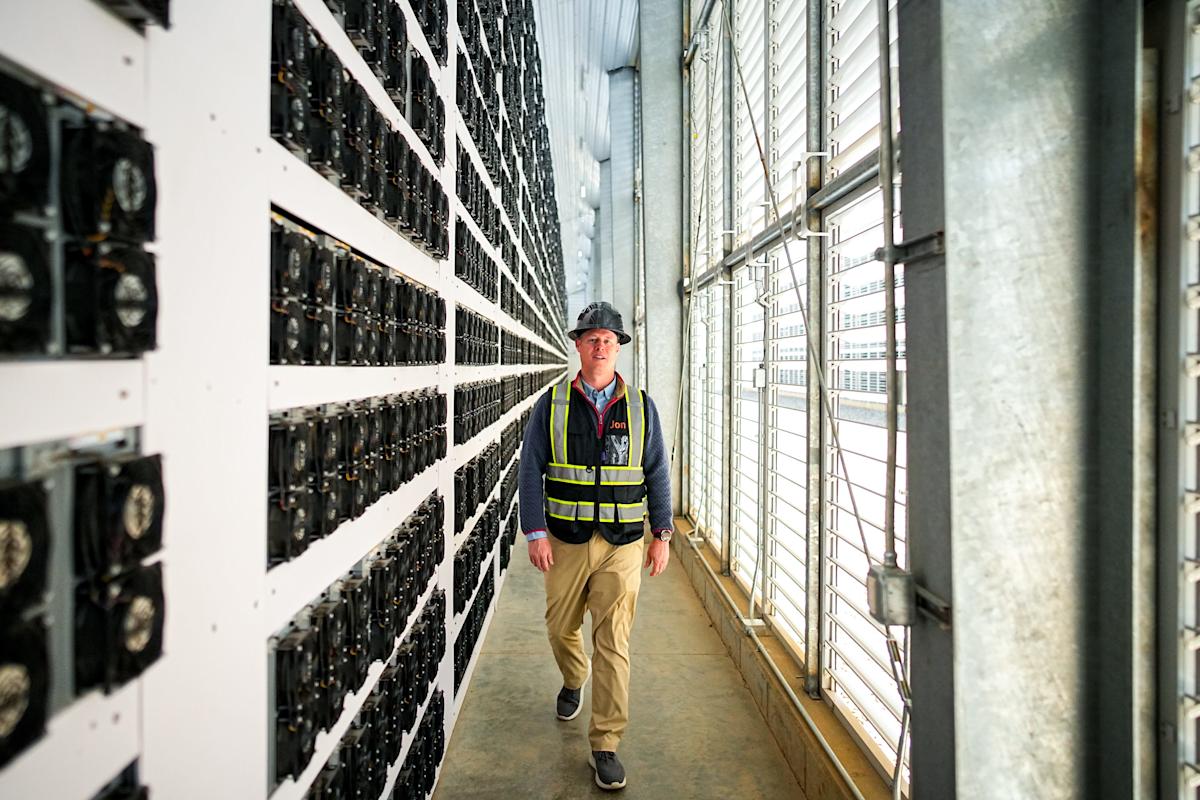
MASSILLON – Inside a gray, metal building along Ninth Street SW, Bitdeer‘s crypto mining servers whir on a long row of floor-to-ceiling shelves.
Lights indicating a network connection blink green and orange on each Sealminer A2 Pro. Steady green lights emanate from the nearby power distribution units — a box of outlets with multiple cords running from each.
“This building is completely operational,” said site manager Jon Wonsettler while providing a tour of Building 21 — one of eight finished cryptomining buildings.
Jon Wonsettler, site manager for Bitdeer, walks the hot side of one of the bitcoin mining facility buildings in Massillon, where the fan exhaust exits the structure.
The Bitdeer site at 1115 Industrial Ave. SW is about half constructed, he said. The first “miners” began work in November 2025, and all 24 mining buildings should be complete by the end of summer.
A single building can hold more than 3,000 machines, which are manufactured by Bitdeer for the sole purpose of mining Bitcoin. In all, there will be more than 21,000 miners on site.
The Canton Repository got a behind-the-scenes tour from Bitdeer to learn about crypto mining and the facility, which operates similarly to a hyperscale data center. Wonsettler described the facility as a type of data center.
In simple terms, what is crypto?
Cryptocurrency is peer-to-peer digital money that exists outside the oversight of banks and third parties.
Bitcoin, which was introduced in 2008, is one of the most widely used forms of cryptocurrency. Transactions are validated by network participants and recorded on a database — the blockchain.
Bitcoin mining is “a network-wide competition to generate a cryptographic solution that matches specific criteria,” according to Investopedia.com. The winning miner receives Bitcoin as a reward, and that process adds new blocks to the blockchain.
Ross Gan, chief communications officer for Bitdeer, described it as a “lottery” of sorts. The company can either hold the mined bitcoins in its treasury or sell them on the open market.
“So, for a period of time, Bitdeer has had some bitcoin in its treasury,” he said. “Recently, we’ve monetized those.”
Bitdeer, a global company based in Singapore, is publicly traded on the Nasdaq stock exchange. Its vertically integrated portfolio includes crypto mining facilities in Washington state, Texas and Tennessee.
According to the company’s monthly operations report, Bitdeer mined 783 bitcoin in April and held 73 bitcoin — compared to 166 mined and 1,246 held during the same month last year. The value of one bitcoin was around $73,000 as of May 29.
Ross Gan, chief communications officer for Bitdeer, walks a portion of company property where a special sound wall has been erected to help limit noise produced by the miner fans in Massillon.
A maximum supply of 21 million bitcoin is built into the network, according to Investopedia.com. The system is designed to lessen the number of bitcoins issued over time and adjust the difficulty of mining, so Bitcoin isn’t expected to reach its limit until 2140, if ever.
Mining for Bitcoin
The mining buildings, either 25-by-100 square feet or 25-by-200 square feet, are being built in two rows of 12. Each end has an entryway with three doors that lead to narrow corridors — the air intake side, the mining servers in the center, and the exhaust side.
Louvers on the sides of the buildings are remotely opened or closed. The roofs slant in one direction, so as to deposit snow and rain on the exhaust side.
The hot side of one of the Bitdeer bitcoin mining buildings, where the fan exhaust exits, in Massillon.
Inside, machine fans pull outside air in through the slats on one side. The air passes through a wall-length filter, which was tinged light brown from construction dust.
“Dust and debris, that’s our enemy,” Wonsettler said.
On the other side of the filters is a coated cardboard “water wall,” which can be dampened to help cool the machines, similar to how swamp coolers work. Wonsettler said that no water had been used since Bitdeer began crypto mining in November, but the company anticipates using 100 gallons a minute for a few hours per day in the summer.
The water that doesn’t evaporate is collected by a trough and returned to the site’s water tanks to be continually repurposed. None of that is ever discharged, and Bitdeer’s water is supplied by the city of Massillon.
“We’re as responsible with water as we can be,” Wonsettler said.
Jon Wonsettler, site manager of the Bitdeer bitcoin mining facility in Massillon, holds a board containing chips used in data miners.
The mining machines blow the hot air produced from computing out the opposite side of the building. On a mid-May morning, the inlet air temperature was 66 degrees and the exhaust temperature was 116 degrees.
Being ‘good neighbors’
Massillon is Bitdeer’s only current location in Ohio. The company is developing facilities in Niles and Clarington but has faced opposition at both locations, according to media reports.
Massillon-area residents voiced concerns about noise before the local project began in 2024, and Bitdeer adjusted plans to include a higher sound barrier. The company constructed a 30- to 40-foot sound wall by the nearest residential area and pledged to keep noise at 60 decibels or less at the property line.
A sound wall was erected to protect a nearby residential neighborhood from noise pollution created by bitcoin mining at the Bitdeer facility in Massillon.
“That’s kind of our main concern, in terms of being good neighbors,” said Wonsettler, who lives about seven miles away.
Bitdeer received no property tax break to construct the nearly $100 million facility.
The company operates its own power substation on the south side of the property, opposite a FirstEnergy substation. Bitdeer uses up to 221 megawatts, which he compared to a steel mill’s electric usage.
At center frame off in the distance, a sound wall can be seen that was erected to protect a nearby residential neighborhood from noise pollution created by bitcoin mining at the Bitdeer facility, in Massillon.
About 40 employees are currently on site, Wonsettler said, and there will be up to 70 when it’s fully operational. Positions include operations technicians, electricians and maintenance workers with starting wages of $22 an hour and an average salary of $82,000.
“It’s progressive technology that will be very relevant in the years to come,” Gan said. “And we’ve made a commitment, also, that it’s not just a site. We have to sink roots.”
The company has donated to various city and community causes, and operations technician Ezekiel Martin said there’s great “camaraderie” among the workers.
Martin, who has an IT certification, does a range of tasks, from routine maintenance on the mining machines to installing servers and setting up networks. He’s worked for Bitdeer for seven months.
“I was born in Massillon. I have family up here,” he said. “I moved away when I was a kid and came back here for better opportunities.”
Reach Kelly at 330-580-8323 or kelly.byer@cantonrep.com